
Orders and (dis)orders in interactions: CSOs and their work with education administration
This article examines how CSOs work with education officials across levels, highlighting challenges and everyday practices. It foregrounds the work and role of supportive bureaucrats in the work of CSOs working towards positive educational change.
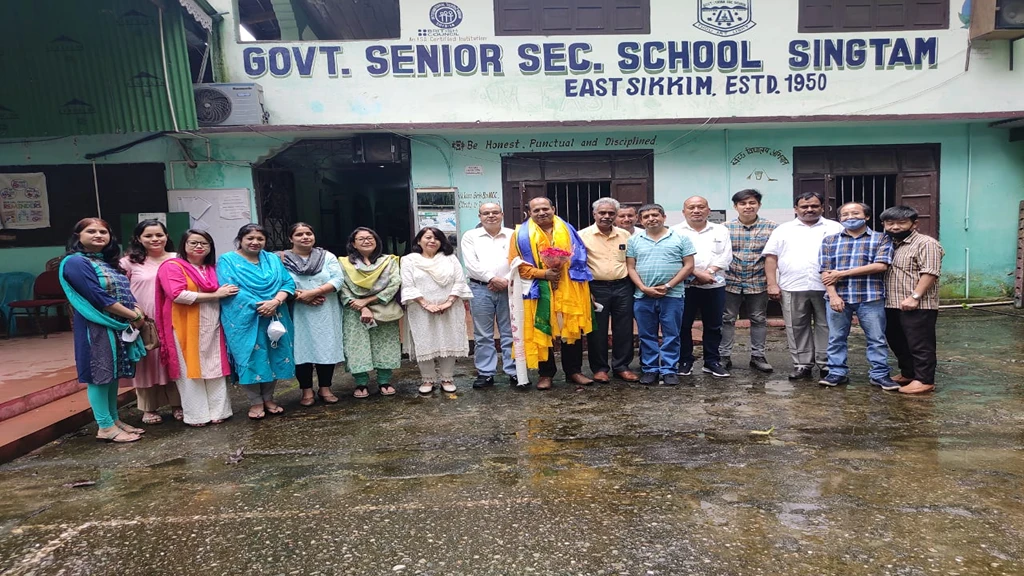
Photo credit: Wikimedia Commons/SINGTAMGSSS
The stakeholders who are most likely to matter to CSOs (Civil Society Organizations) working with the public school system, are teachers. Ultimately teachers are expected to be the agents of change with their direct engagement with teaching and learning. However, there is another stakeholder, occupying different levels of the hierarchy of the public education system. This hierarchy extends from senior state offices to the district, block and cluster levels, with which CSOs have to interact with in terms of their shared work toward educational change in the school system. It is the members of this hierarchy who are often forgotten due to their perceived indirect engagement with teaching-learning that we are interested in–the bureaucrat. Simply put, these are the members of the education administration or management system.
Understanding mid and low level education bureaucracy in India
Bureaucrats and their work have been an area of interest in academia, across multiple disciplines such as sociology, political science, anthropology, economics, and public policy. This is so because the work of bureaucrats is inevitably linked to understanding the implementation of policies and programs of the government. Different disciplines have used a range of theories and tools to examine, understand, and explain the work of bureaucrats and the education administration system.
In a brief examination of these concepts here, we see that many of these ideas have bearing in terms of the linkages between CSOs, the school administration system (bureaucrats), and different stakeholders that both the former actors have to interact with in their everyday work. One such concept is that of the principal-agent problem. Here, elected representatives and bureaucrats or even senior officers and junior officials or teachers may find themselves pursuing different objectives.
This can lead to a misalignment in work-related goals between higher ups and junior officials. For example, while bureaucrats (state and district level) often have objectives of scaling-up of innovative or exemplary work of local CSOs, the CSOs may be more interested in deepening their work and keeping it limited in terms of scale. CSOs may want to do this due to internal reasons, e.g., vision of the CSO and further knowledge-building in the domain, etc. They may also want to go in for depth rather than scale because of external reasons that may include limited availability of human and financial resources.
Another concept called ‘street-level bureaucracy’ helps one to understand the pressure of multiple programs, government orders, and top-down management information systems under which junior officers and teachers need to work in the government school system. For example, DEOs (District Education Officers), BRCCs (Block Resource Centre Coordinators) and CRPs (Cluster Resource Persons) are administrative officers who are closest to the final delivery of education in schools. However, they often have to align their work to administrative pressures instead of issues of education quality.
For example, in a situation where a CSO is working toward qualitative improvement in teaching-learning processes in schools, the focus of the school and related administrative officials could be limited only to improvements in enrolments and attendance of children and teachers, and so on. The possible complementarities that could have been derived between the CSO’s work and the administrative structure, if the qualitative criteria (e.g., teachers’ capacity; students’ learning challenges and pathways of progress) of the CSO received precedence, are derailed in such a situation.
Related to the above is the idea that the ways in which the overall administrative system works orients lower-level bureaucrats to orders, targets, and incentives from superiors. Such a ‘cognitive mapping’ (mental schemas) of street-level bureaucrats, vis-à-vis that of superiors and that of ultimate beneficiaries (teachers and students), also create contradictions in the everyday work culture in the education administrative system. For example, DIET (District Institute of Education and Training) nodal officers, BRCCs and CRPs may be more inclined to monitoring and inspection rather than mentoring teachers when they visit schools. For CSOs working through collaborative and participatory approaches to build capacity among teachers in these schools, such visits can be counterproductive. Teachers, in turn, could revert to conventional approaches to teaching-learning under pressure of meeting targets that such monitoring often comes with.
The importance of bureaucratic activism in the grassroots
It is not that frontline education officials only offer challenges to the grassroots work of CSOs. Despite the layered complexity within which education administrative work is embedded, the CSOs often have found champions and support for their work from among these bureaucrats. Unfortunately, the idea of ‘bureaucratic activism’ as a concept has been mostly used to discuss support from senior officialdom; for example, in the context of implementation of the Activity Based Learning Program in Tamil Nadu. Engagement with CSOs reveal that they have often found momentum and reinforcement for their work from such activism at even the lower levels of the education administration hierarchy.
In this context, we seek to build an archive of voices from the field that can throw light on the relationships that take shape between education CSOs, education bureaucrats, and other stakeholders at multiple levels. Through our effort, we want to draw out and understand the various ideas that have been used to describe the functioning of government administration through the everyday work of education CSOs and education bureaucrats.
Understanding collaborations between CSOs and the education bureaucracy for educational change
In this context, capturing the voices of senior bureaucrats sharing their experiences of educational change where CSOs have formed one of the key anchors of the change process is important. These bureaucrats are mostly key policy actors at the state or central level (incumbent or retired), who have played/ continue to play significant role in policy and program implementation. Their sharing about the processes through which different stakeholders, including education CSOs, form effective partnerships for education change can help us understand this process better.
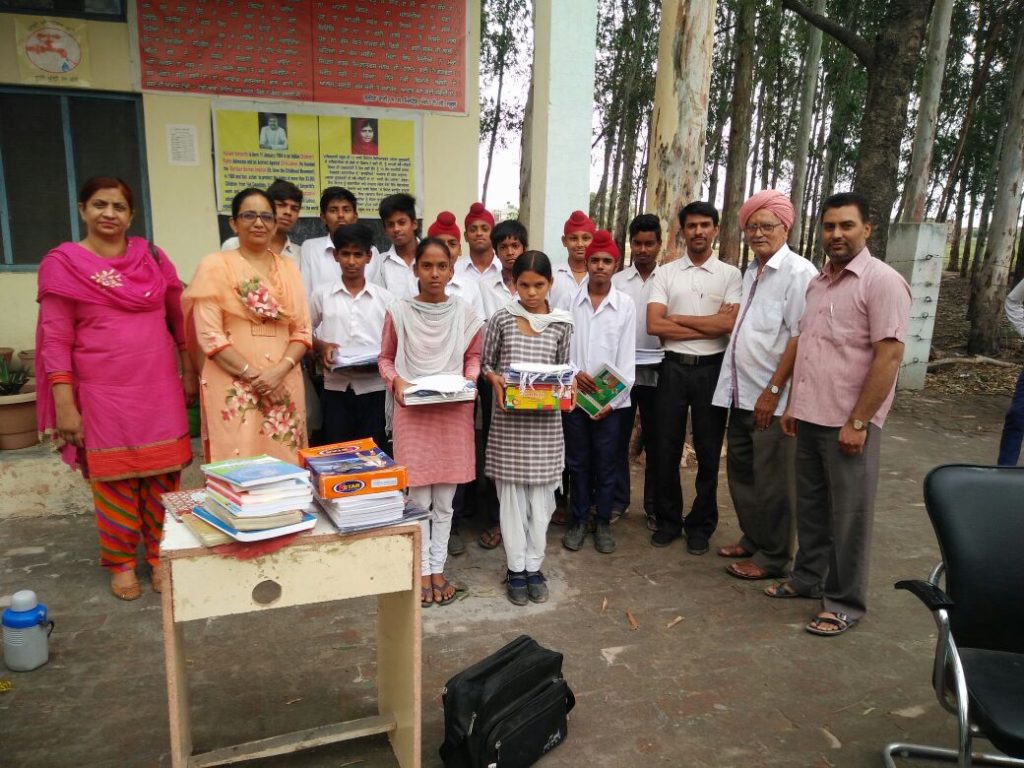
Photo credit: Wikimedia Commons/Vinod Kumar
Narratives of CSOs who have been able to generate positive synergies for their work through the direct or indirect support of mid-level (district or block) bureaucrats and how they have been able to do so is an important aspect of developing an understanding of CSO-bureaucracy relationships. These help us underscore how bureaucratic activism operates as a positive force for CSOs even at the middle and lower tiers of the education administrative system.
Human Interest stories that cover the life history of frontline bureaucrats who have provided active guidance, support and leadership to the work of CSOs at the field-level is also an important element of capturing CSO-bureaucracy collaborations. These stories can help us reflect upon how, despite several challenges, street-level bureaucrats are able to make a difference in terms of educational goals of the larger system in which CSOs, other stakeholders, and these bureaucrats are equally invested.
The proposed archive of such narratives hopes to develop a better understanding of both the order(s) and disorder(s) that make up the interactions and collaborations between educational CSOs, bureaucrats, and the bureaucracy in their work toward educational change. It intends to unpack the synergies and tensions that characterize such interactions. It also hopes to bring to the forefront experiences and examples that education CSOs who need to engage with the education administrative system at different levels can learn and benefit from.

Related Articles
By | October 30, 2025
No approved comments yet. Be the first to comment!