
Paired reading in children’s libraries
This article explores the library practice of paired reading. It shares how the activity is able to engage children in deep diving into literature collaboratively.
Becoming engaged readers
In today’s world, we expect all children to become readers. This brings the act of reading to a strong focus for all of us. What does reading mean to us? It is the act of decoding a script fluently and comprehending the plain meaning of words. Beyond this, we intend our children to make sense of what they are reading, and to relate it to their world and their experiences.
Yes, the library is a place where we want children to pick a book, read it, stay with it and build connections around it. However, it is often challenging to motivate children to engage in reading. An even greater challenge is to enable them to engage with the books in a deep meaningful way which not only improves their reading habit but also encourages multifaceted learning. One activity which holds the promise of engaging children in the act of reading meaningfully is paired reading.
Paired reading is generally viewed as a collaborative learning strategy where two children (at times, a fluent reader and a less fluent reader) are paired. They take turns reading a text. When one child reads, the other listens and supports. This strengthens the reading skills of both children eventually. This activity is generally useful in inculcating skills of reading fluency and comprehension through positive peer interaction.
Paired reading activities at Bhabook
The activity of paired reading that we explore here is slightly different. It is meant for children who have acquired the skills of reading fluently and are able to comprehend the meaning of the text independently. It intends to enable children to engage with books independently as well as with a partner and participate in meaningful discussions around a pair of books. In paired reading, a pair of children are provided with a pair of books.
The pairing of books is of great significance as it is practically the backbone of the activity. The paired books must be based on similar topics/themes and have several similarities and differences as well. Each child of the pair takes a turn in reading both the books independently. After reading, they are to engage in a discussion around certain pointers that the facilitator would have shared with them for observation in the books during the reading.
The discussions generally revolve around identifying the literary elements of the stories. These include the stories’ plot, setting, characters and themes. The pairs are encouraged to identify the similarities and differences between the texts (including the illustrations, if any) and form their personal responses around the texts. They also state their preferences between the two texts along with the reasons.
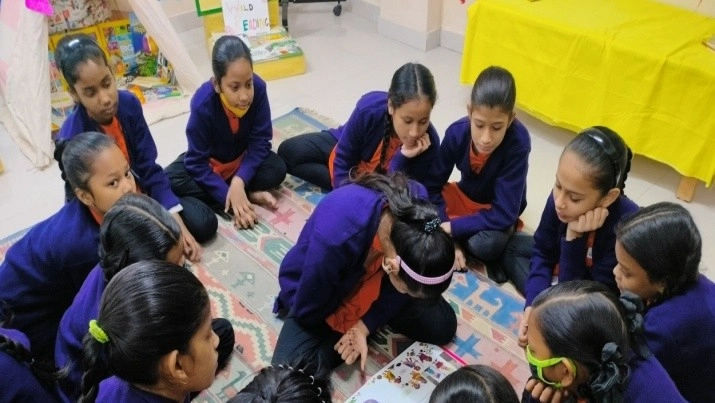
Photo credit: Bhabook Foundation
Creating shared meaning
The children note the key points emerging out of their discussion (based on the pointers) in writing. They then share these with a larger group of children. During the sharing, the children are expected to share a summary of the stories and state their personal responses and collective observations on the books. It must be noted that the discussion points can be reframed based on the age, abilities, interest and needs of the children engaging in the activity. For example, when children are asked to identify and discuss the literary elements of the stories, they must know what the literary elements of a story are. They must also have prior experience of identifying the same in a story. Based on the prior knowledge and the skill sets needed, this activity is suited best for children in the middle grades and beyond.
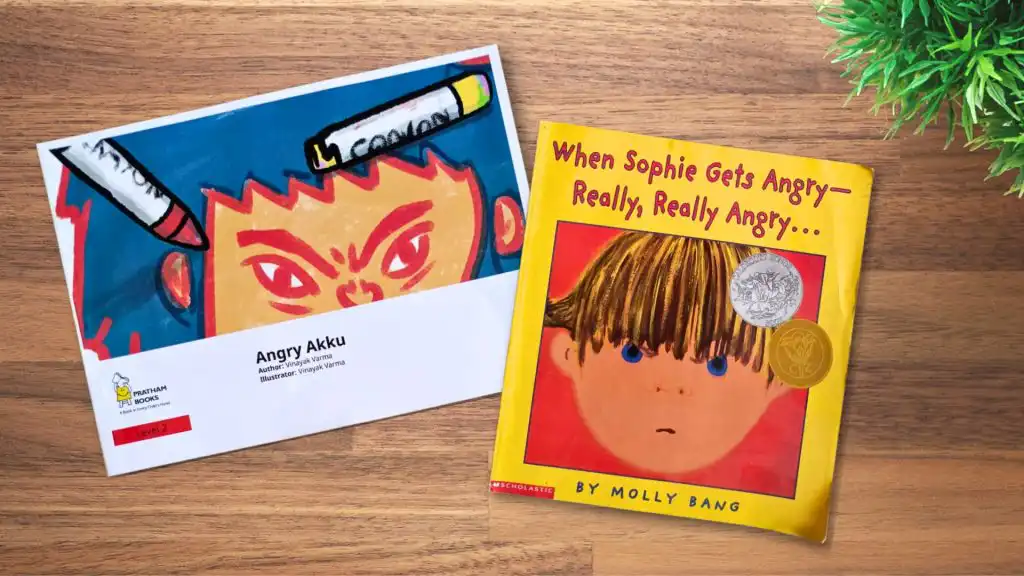
Let us explore the activity with a pair of books. A very popular pair which children love engaging with are ‘When Sophie gets angry, really really angry’ and ‘Angry Akku’. Both the stories have a running theme of ‘anger’ and how the main characters overcome their anger in the course of the stories. This forms the main crux of the similarity, based on which the books are paired, which children identify easily.
The role family plays in the storylines are different. In Sophie’s story the family is practically in the backdrop, whereas in the story of Akku, the father plays a pivotal role in helping the child manage her anger. The children are able to identify the intent of the authors in projecting a female child as the protagonist in both the stories, as if to normalize the fact that girls too can get angry. The absence of Akku’s mother in the story and the father’s character taking predominance is well-appreciated by the children. They are clearly able to respond to the text through the lens of gender and societal norms.
Children also appreciate the color palette used in the books to depict anger, especially the bright red hues of glaring anger in Sophie’s story and the gradually fading red color to depict diminishing anger in Akku’s story. Finally, the diverse expression of anger depicted by the stories enables the children to reflect on the ways in which they express anger and the role their family members play in such situations. This helps them create personal connections and build responses to the stories.
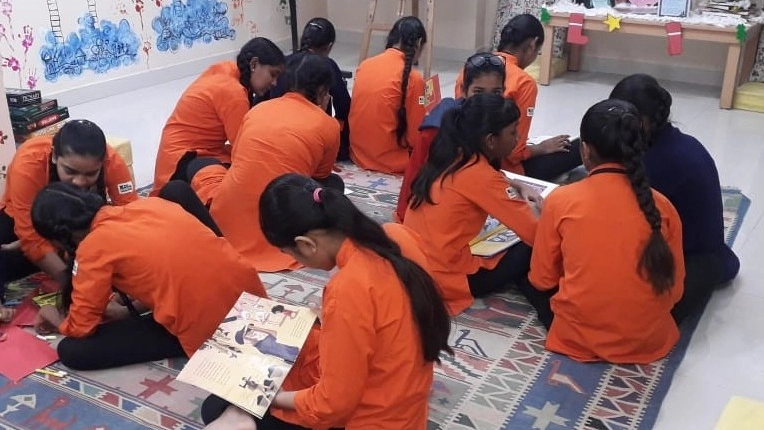
Photo credit: Bhabook Foundation
Another pair of books, which generates intense discussions during paired reading activities are ‘Why why girl’ and ‘The boy who asked why’. Children are quick to identify that both the stories are inspired from real-life characters. This gives them an opportunity to understand the distinctions between the genres of fiction and nonfiction.
The indomitable spirit of the main characters in asking questions challenging inequality and injustice is the topic around which both the stories revolve. The caste oppression that is suggested in both the stories is a point highlighted by children during sharing. They are also able to consciously identify other forms of inequalities that are present around them.
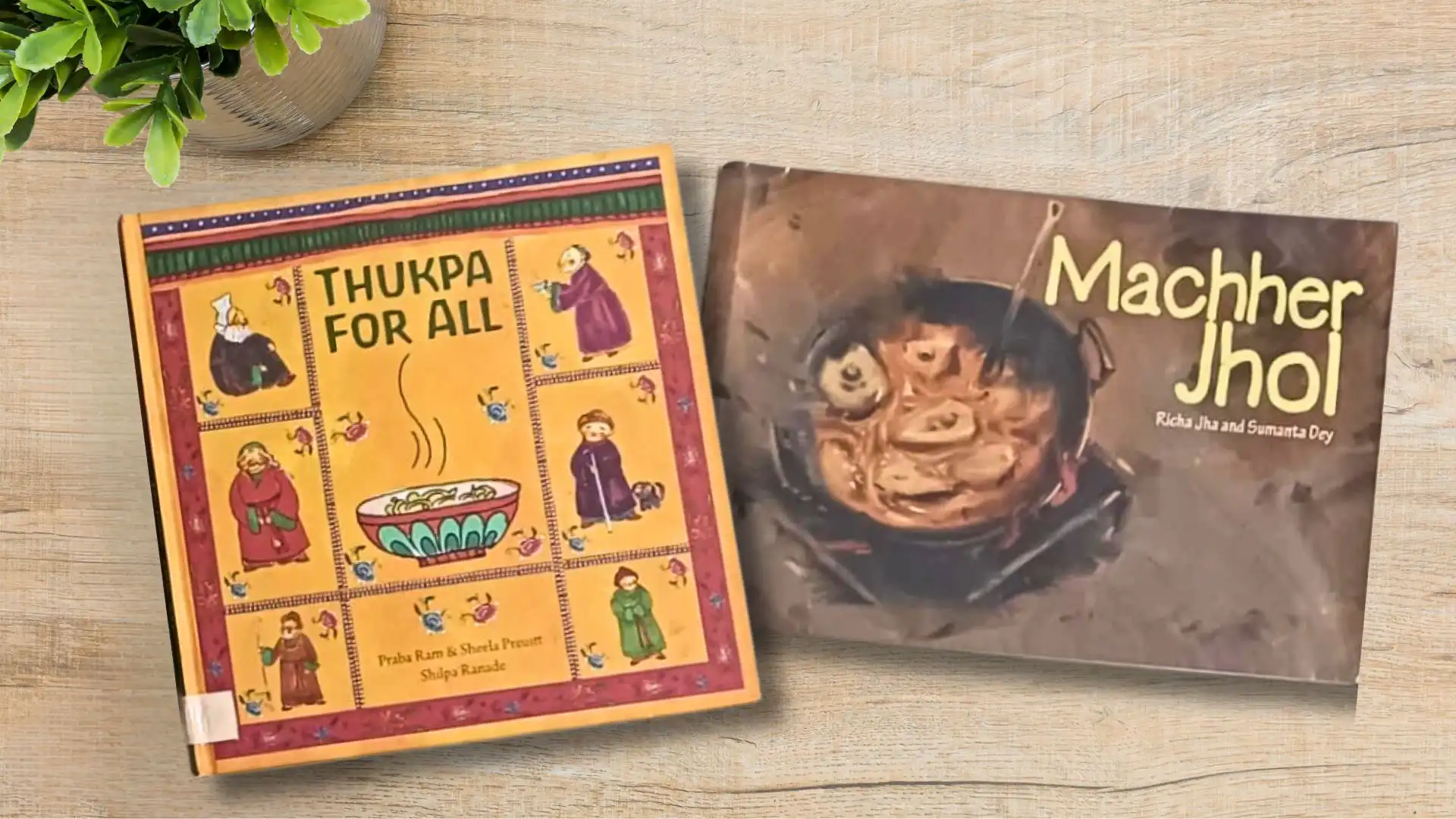
Similarly, ‘Macher Jhol’ and ‘Thukpa for all’, another set of paired books, enable the children to identify the similarity in the stories being about visually impaired children and how the characters are portrayed in a positive manner. The books give an opportunity to explore the auditory and tactile senses of visually impaired children in a new light. The fact that both the stories are located in diverse cultures is well-appreciated by the children.
As an extension to the activity itself, I have observed that after engaging in paired activity a number of times, children are able to pair books based on similar themes. A group of children assigned with the task to pair books from their library collection successfully paired ‘The lonely king and queen’ with ‘Our John’ and ‘Jamlo Walks’ with ‘A suitcase for Surta’. The children are, thus, able to understand the nature of activity and criteria of book selection. They are also able to connect the information to the books that they have read to create a new pair of books for the activity. However, this is not the primary aim of this activity but rather an interesting possibility to explore.
Conclusion
Paired reading is an activity that has the potential of enabling children to dive deeply into books. It encourages them to look beyond the mere textual comprehension of the stories and discuss their intricate structures. The children are compelled to extract the stories’ themes and subthemes and analyze them based on their thematic frameworks.
This provides them with an opportunity to deconstruct a story to its skeleton to observe the details of similarities and differences. Moreover, the children are able to connect the stories with their own lived experiences and the world around them and develop personal opinions around the same. They not only form their opinions based on their own understanding but by hearing out their partners through an interactive process.
Children often express how their partners’ insights shape and inform the way they read a book. Thus, paired reading transforms reading into a social act to be shared with others and an opportunity to explore books collectively. The act of sharing (in writing and verbally) involved in the activity refines the readers’ articulation and enables them to express themselves with confidence to their peers.
Paired reading is a very useful tool in understanding the way our children are navigating literature when they read. It informs us of their abilities and provides us with an opportunity to steer them toward appreciating and developing a critical understanding of literature while reading books. It provides the children with a chance to hold on to a book. It helps them read and discuss books collectively. In the process, they are able to create a relationship with books and become engaged readers.
Related Articles
By | October 1, 2025
By | October 1, 2025
No approved comments yet. Be the first to comment!