
Diverse geographies, diverse libraries
What does a library mean for the different children across the country? What has been the role of libraries in creating safe learning spaces in the face of disruptions caused by the COVID-19 pandemic and other adversities? How does a library take shape in a community? What are the struggles and challenges of libraries across […]
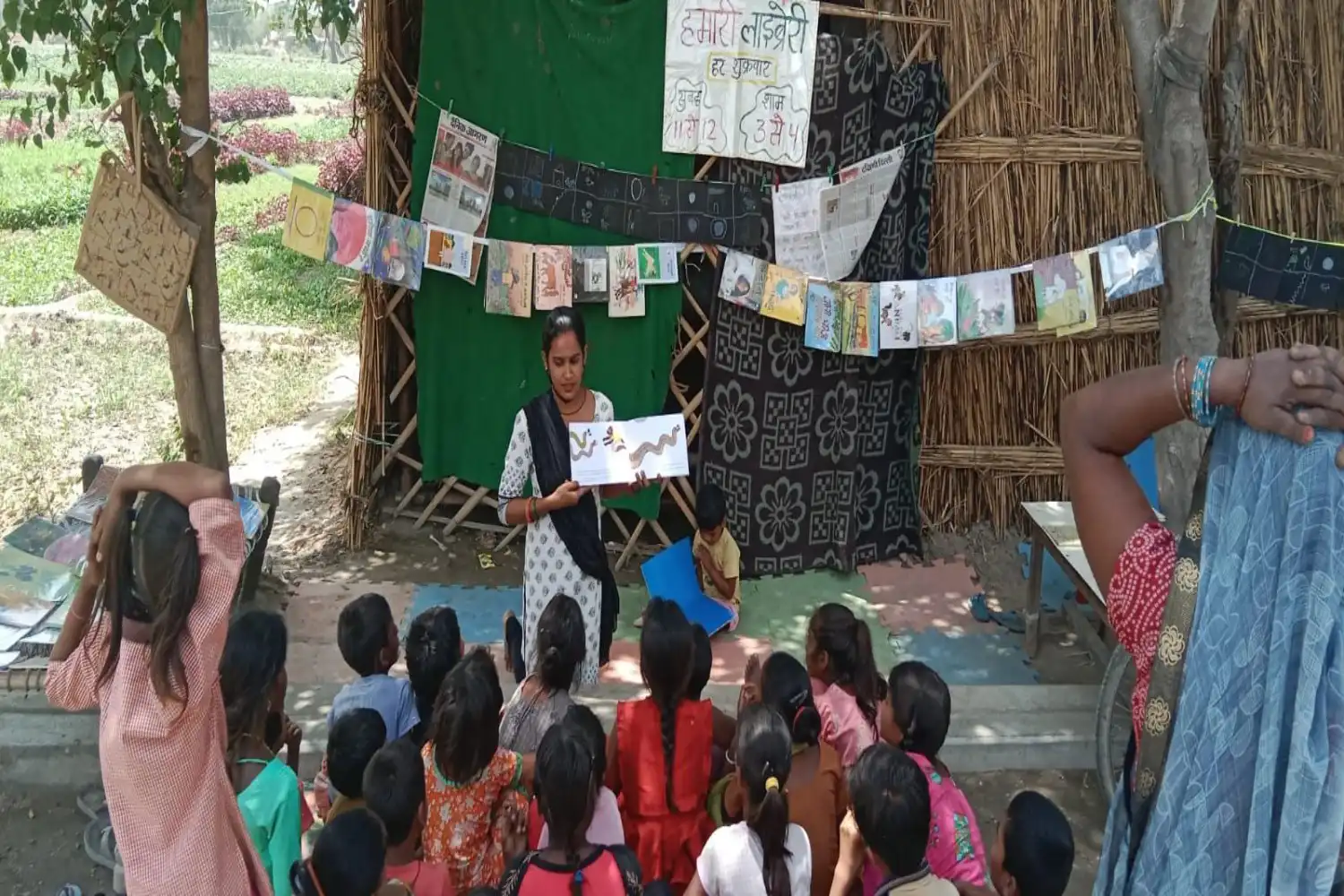
What does a library mean for the different children across the country? What has been the role of libraries in creating safe learning spaces in the face of disruptions caused by the COVID-19 pandemic and other adversities?
How does a library take shape in a community? What are the struggles and challenges of libraries across the different geographies of India?
In this article, we try to cover the experiences of different organizations working with children and communities through their library initiatives in distinct geographies. Each of these organizations gives us a different picture of the possibilities that libraries offer.
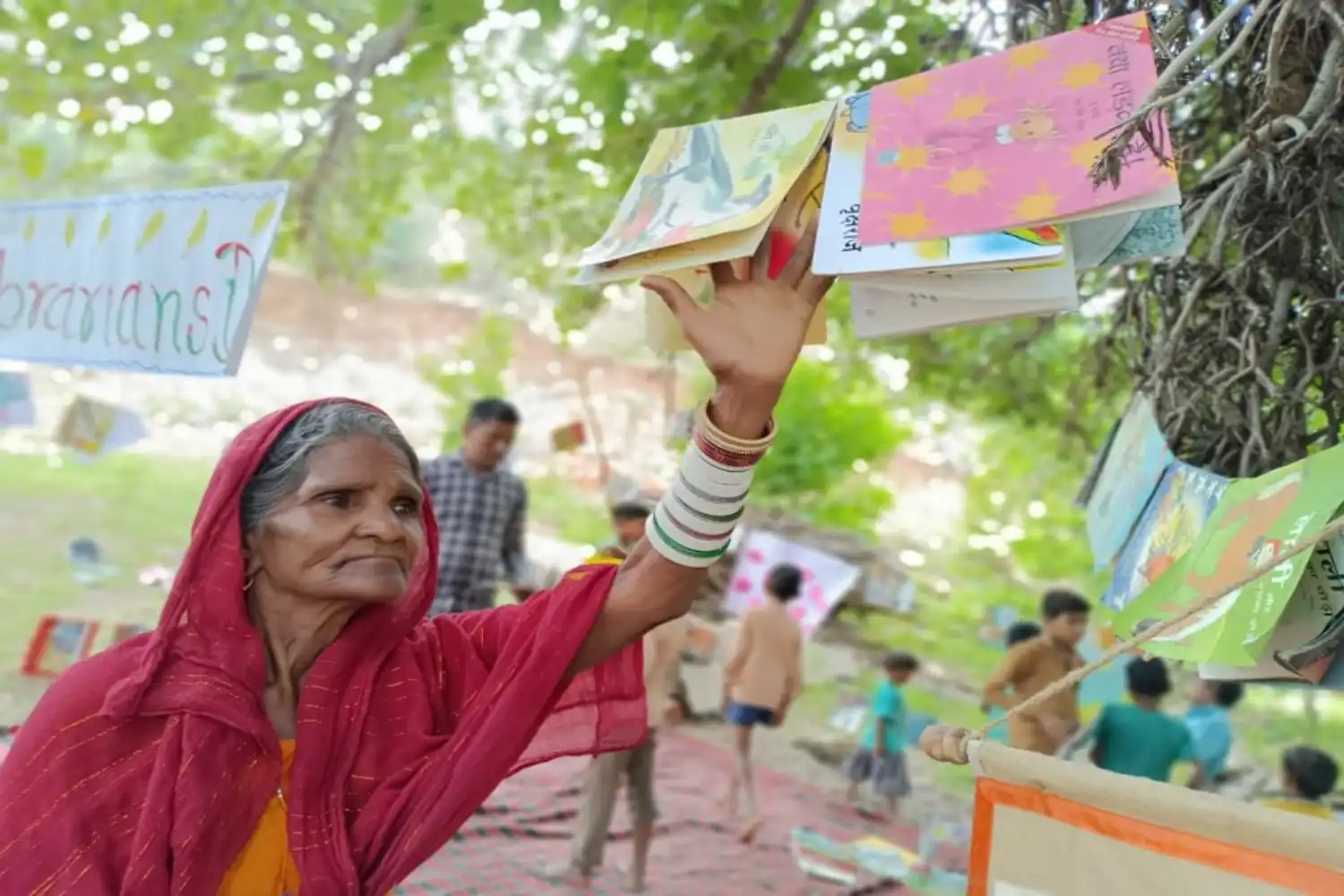
Libraries run by these CSOs are turning into open, creative, and engaging spaces of learning for children. They are collaborating with communities and schools to promote the culture of reading and to make learning processes child-centred. In this piece, they share what it takes to sustain a library when the community has a major role to play in it.
Ayang Trust
Ayang Trust is a nonprofit organization based in Majuli, Assam. It runs the Hummingbird School, a community-based progressive school. The CSO tries to reach as many children as possible through engagements with the community and formal school processes.
However, during the pandemic, the education programs were discontinued, as schools were closed. Children also faced disruptions in their learning.
Therefore, Ayang felt the need to directly engage with the community to create access to spaces and resources for the learning of children. They envisioned a community library as a response. The vision being to bring social change to villages through the mission of Seeding Enquiry, Empathy, and Dialogue (SEED) in children, youth, and adults by using books as tools.
Ayang establishes community libraries in collaboration with villagers through a participatory approach. Communities provide the space and form a Library Management Committee (LMC). Ayang provides a curated set of books. It also trains a local library educator (Xopun Sarathi) and the LMC members.
The ‘Xopun Sarathis,’ i.e., ‘Dream Charioteers,’ are trained and supported in seeding reading as a cultural practice and to meaningfully engage with the children and the youth.
“Taking ahead the concept of a community library initially, we piloted it with four villages in Majuli in November 2021. Based on our observations and learning, processes and systems to start engagement with another 16 villages were designed. Gradually, over 8 months of engagement with these 20 villages, our community library model has evolved,” shares Team Ayang.
The democratic and participatory process of setting up a community library involves elaborate dialogues and discussions with the villagers. It emphasizes understanding the context of the village.
This process also highlights the role of a community library in the villages’ growth and development. However, the major challenge that Ayang witnessed in the initial phases was related to the villages’ hierarchical social structure.
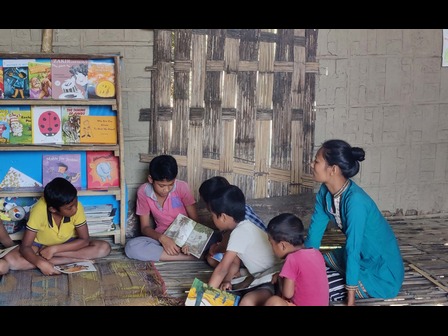
These hierarchies are based on caste, class, and gender. People from the same dominant groups are being selected for various roles in the libraries. Considering the challenges, the Ayang team is trying to make the processes more inclusive in nature. Presently, it is looking forward to experimenting with the idea of equal participation of Ayang and the villages in the selection processes, at least in the initial period. It is envisaged that, gradually, complete ownership will be transferred to the villages.
A Xopun Sarathi engages with the children through a variety of library activities. ‘Reading aloud’ is the core activity of the library sessions. It enables a space for children to think, reflect, and connect to different aspects of stories and develop an interest in reading.
To introduce children to new titles, themes, authors, and vocabulary building, the Xopun Sarathis engage with children through fun-filled and enjoyable library games. These include treasure hunts, word games, Snakes and Ladders, and musical books, etc. Based on their understanding, learning, and experience, Ayang has been able to map out four major components of the community library model. They think these aspects are significant for its success. We discuss these below.
Accessibility to the library: A village library should have adequate infrastructure and reading resources such as books and other stationery. The library should be open for at least 20 days a month. This function should be supported by trained Xopun Sarathis and LMC members.
Usage of the library: Children must be able to borrow at least two books a month. They should also be facilitated to share their experiences with their peers. Also, 70% of the registered children should visit the library at least 15 days a month.
Community ownership and sustainability: Ayang believes that a village’s reading culture can only be developed when villagers come together and run their library instead of an organization running it. So, in their two years of engagement with the village, they try to develop this sense of ownership in the village. The goal is that when Ayang gradually terminates the support, the library can still function on its own. The visible indicators of community ownership and sustainability would be financial ownership of the library by the village, and active engagement by the youth and LMC members with the library.
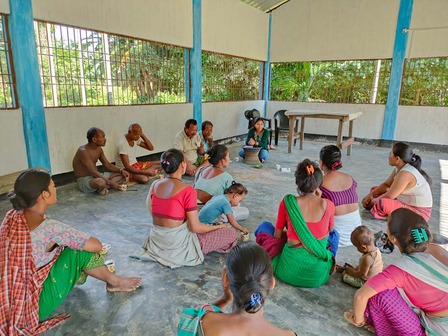
Merits of reading: Ayang believes that a reading culture will develop when the village understands the merits of reading. This can be observed from community participation and support in the library’s processes. One indirect indicator can be financial contributions made by families to sustain the library. A family would contribute money only when it thinks that it’s an important activity.
Currently, twenty community libraries have been established by various communities in Majuli. By the end of February 2023, 20 other villages were preparing to start their own community libraries.
However, the journey of reaching out to this number of villages has not been easy. Ayang has developed the whole process in a two-year project with clear objectives and activities. They are continuously learning and innovating through these processes and structures.
Through their SEED project, AYANG aims to establish 200 libraries in rural Assam. These are envisaged to be owned and sustained by the villages themselves. The team expects that this will create a ripple effect. The goal is to inspire more and more rural communities across Assam to establish and own the functioning of thriving community libraries. These institutions are envisaged to be at the forefront of social change. Further, the successful practices that come out of this endeavor could be a guiding model across rural India.
North East Education Trust (NEET)
North East Education Trust (NEET) runs a community library in Guwahati for children, youth, and community members. The goal is to make children and other people come together to engage and express through their heads, hearts, and hands.
As the entire world went through upheavals during the COVID-19 pandemic, children were affected as well. The pandemic gave access to mobile phones and the internet to many children. However, it ended up keeping them over-involved with phones. It also made them habituated to staying indoors. Post-pandemic changes in children’s behavior and choices are something the NEET team is still struggling with.
Saradi, a team member, shares her recent experience with young readers, “After the re-opening of the library, we could observe a kind of growing gap among the children and the library. They were losing interest in reading books and in taking part in library activities. Earlier, they would come to the library without any fear of judgment. They used to share their worries and problems directly with their educators. Even though they never expected anything out of their educators, they had a certain faith and a feeling of friendliness. Due to this, they openly shared what they had to.
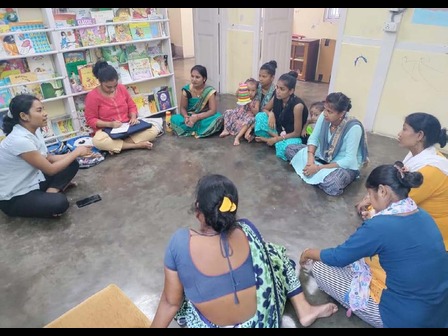
“However, after the pandemic, children started using cell phones as an escape from the problems and the issues they faced in their day-to-day life. They started maintaining a distance in the library. The same set of children, who were active participants earlier, started being irregular.”
On realizing this issue, we started taking extra interactive sessions. We also went on regular community visits to invite children. We started interacting with their parents on a regular basis as well. Throughout this process, we added a new rule of ‘no mobile during library sessions’ for the children. With the passage of time, we now observe a positive change among regular library participants. However, we still have a lot of work to do.”
rZamba Trust
rZamba Trust started in 2015 as a volunteer group of friends and began working in government schools. While doing this work, they got to experience what it is like to work in a place like Kargil. This remote region is on the country’s border. Here, climatic conditions are difficult with respect to the terrain. The sociopolitical conditions are also different. All these factors affect people’s lives.
To address the region’s issues, rZamba began intensive engagement in education in 2018–19. Saldon, from the rZamba team, shares that their program is currently called ‘Holistic Child Wellbeing Initiative.’ As a part of this initiative, they try to bring in all the stakeholders on a common platform. The goal is to develop a common understanding of educational leadership as a collective. They also want to move towards ensuring a better future for their children.
As a part of this program, they have had intensive engagements with government schools in terms of pedagogical interventions. As a part of this process, project-based learning is introduced into the classroom curriculum.
Apart from that, they are also focusing on creating good library spaces. They want to foster libraries as places of growth and develop the involvement and appreciation for libraries among all the stakeholders in the communities they work with.
rZamba’s current focus is on foundational learning years. A library space is introduced to the children studying in nursery to class 3. The objective is to be able to generate their interest in books and reading so that they become lifelong learners. rZamba ensures the inclusion of books catering to their learning needs. For example, some might contain more pictures and fewer words, depending on the children’s class, age group, and learning levels. Currently, their focus is mainly on bringing more and more learning material for children up to Class 3.
While speaking about the challenges, Saldon shares, “Unfortunately, there is very less contextual children’s material when it comes to Ladakh, especially in terms of story books. We don’t get a lot of stories from Ladakh. Most of them are in oral form. We try to get diverse books, which may not exactly be related to Ladakh’s context. However, the story and the background do help in relating and connecting the children, as a mirror, at times.”
Community youth facilitators work in schools for the entire day. With the help of teachers, they are trying to ensure that a library period/library session happens in every class. They also work to enable various kinds of library activities. They engage with the teachers through library sessions. They also try to build their own capacity and figure out how to pass this on to the community after three years of intensive engagement.
What really works for rZamba is the value of co-creation that they emphasize on, be it with communities, the children, or with the teachers. For example, they develop a sense of ownership when they cover a library book or make their own library card. Another thing that has helped to draw children towards books is by introducing simpler books at first. These may be picture books or books with very few words. Children can relate to such texts.
rZamba’s team helps the children read, letting their peers listen to them, and feel appreciated for what they are doing in the library. All these things have created a shift. Children now feel confident about themselves. They may or may not be doing very well right now. However, they have the ability to become good readers in the future.
Saldon shares that they face challenges related to resources, connectivity, and funding, as they live and work in remote areas. The current education structure also stands as one of the barriers in reaching out to children through libraries. The way schools and education are structured, these do not give much importance to libraries.
The rZamba team struggles with seeking cooperation from teachers. Even though they are convinced that libraries are important, they are also stuck in loops. It needs a lot of motivation for them to go beyond their comfort zone and pick up a library book or use library sessions as a way to teach something from the curriculum.
Library practices used by rZamba have the potential to make the curriculum interesting and engaging for children. However, the main challenge remains as to how to make this method a part of the curriculum.
Saldon further shares that there is a need for systemic interventions in order to achieve this. The rZamba team is also engaging with the Directorate of School Education to sustain this intervention. Currently, rZamba works with 10 village communities. Here, they have signed MoUs with the Village Education Committees. They are also collaborating with the local administration for a more systemic approach.
LECIN
Let’s Educate Children In Need (LECIN) is a nonprofit organization started in 2015. Their work focuses on early-childhood education and free library programs. They first began their library work in 2019 in Baalwadis. However, later, due to the COVID-19 pandemic, they began setting up pop-up libraries in different villages. This was the beginning of their community library program.
Since 2022, LECIN has been able to reach out to 800 children through the Free Community Library Program. This initiative serves communities along the Yamuna River in Delhi and Uttar Pradesh (UP), and a village in Shamli district in the latter state.
Although LECIN works in and around the National Capital Region (NCR), Delhi, the communities it works with are highly secluded from the rest of the world. They live in difficult riverine catchment areas of the Yamuna. Many children in these communities hadn’t seen picture books before the organization started its interventions.
At present, 150 to 160 members are connected with the library in the villages. Out of this, 90–100 children (2.5–18 years old) come on a daily basis. On average, 50–60 books are issued/returned daily.
LECIN’s Khoj program (free community library) aims to include people of all classes, castes, religions, and genders. Its goal is to promote ‘Reading Readiness’ and ‘Joys of Reading’ through the library, a library that is run by and for the community. Library activities, like read-alouds, storytelling, games, book talks, events, songs, poems, drama, and other physical, cognitive, art, and language activities are included in the library sessions.
Ankush, a team member, shares that once they asked the children in a library session, “What is a library for you?” So, a child said, “The library gives us a place to say what we have to say.” Another said, “Here we study, dance, and sing.” An older child said that he gets information about the world in the library, and that it is fun to listen to stories.
Another team member, Nupur, shares about two of the biggest challenges that have come to the fore. “As the houses in the communities were not always owned by them, getting a closed, covered space for the libraries is difficult. During the rainy season, the water level of the River Yamuna rises. Due to this, many people migrate upstream. So, running our libraries in such an environment becomes very challenging. We have had to keep the library closed during the monsoons.”
Also, seeking the support of the parents in the community was a bit tricky. Instead of going to a library, if their child helps in the field, it would be of more immediate financial benefit for them. To tackle this, the organization also started taking sessions with parents for raising awareness among them.
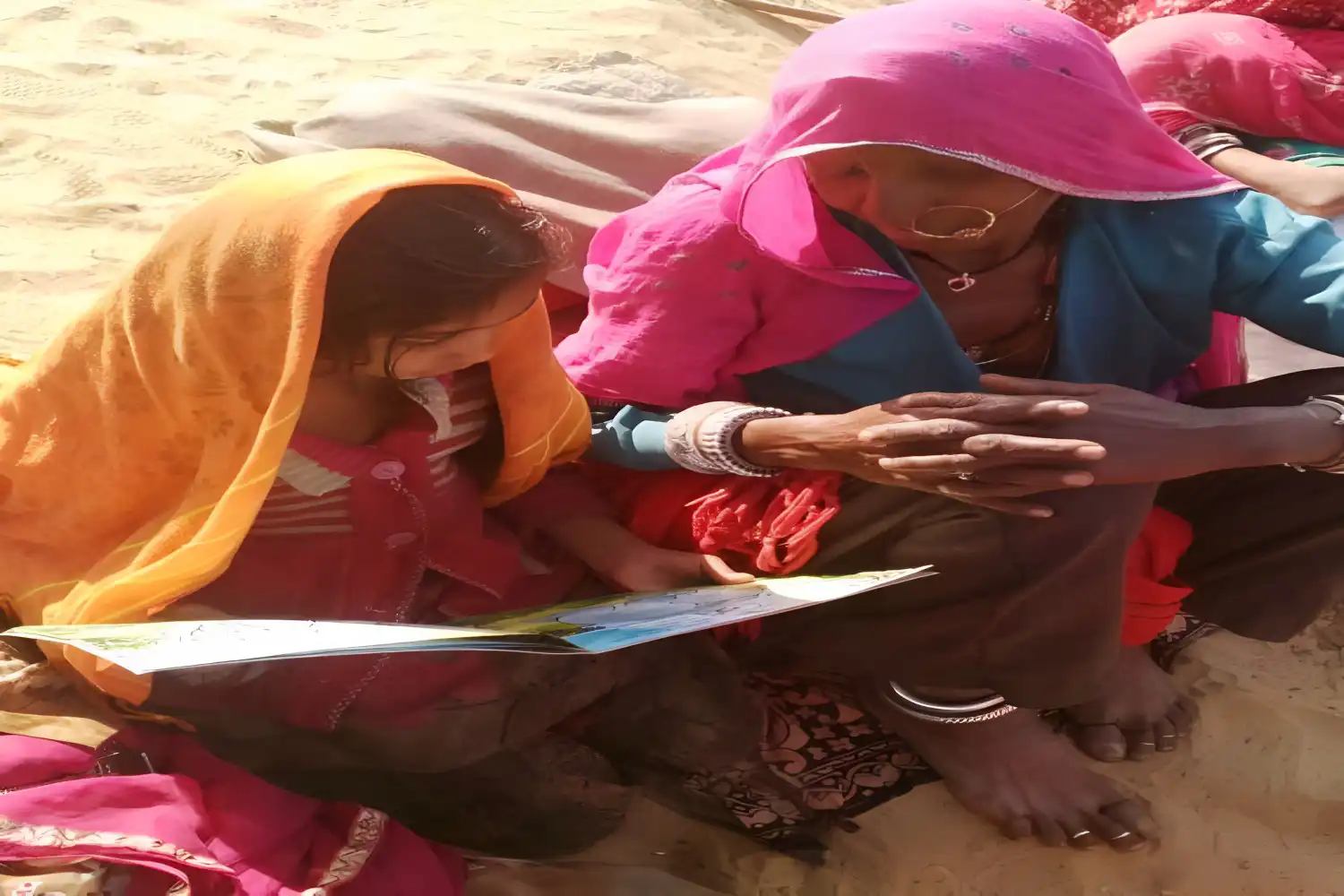
This has led to many elder participants also entering the library. They often did not know how to read and write. They started attending the sessions. This generated their interest in libraries. They have now begun to understand stories through pictures. Sometimes, they would start narrating the whole book by themselves. After this, the libraries have become more inclusive to include all age groups.
Taking this learning and engagement with the community further ahead, LECIN has had a series of discussions and meetings. They were mainly based around questions like—What kind of library do they (the villagers) want? What all should it comprise? From these conversations, they came to know about their expectations from the library. These include games, newspapers, and activities for children, including the older ones, due to which other members could also join the library. The main learning has been that the more the number of people from the community who join the work, the more meaningful and effective is the change that can happen.
At the same time, there should be something for everyone in the library. If the solution to the problems of the community also comes up during discussions of the community library, then it becomes a process filled with fun, love, and ownership.
Makkala Jagriti
Makkala Jagriti (meaning ‘Awakening of Children’) is a Bengaluru-based organization, founded in 2003. Its goal is to create a value-based social movement to empower children and their communities. Libraries are one of the critical components of its holistic development and learning program. Their library is aimed at all children in the 6–14-year age group. They strengthen school libraries with creative ideas, activities, and methodologies, where school teachers are involved in the library activities. Key components of their library work include the following.
Reading for pleasure: Children have ‘Reading Time’ where teachers/facilitators and children sit with a book of their own choice and read it for half an hour or so. Teachers/facilitators could see that this activity impacts students’ focus. It also helps imbibe the habit and love for books.
Foundational literacy: The organization tries to bridge gaps in children’s foundational literacy skills. It tries to do so through access to books at different levels and support from facilitators. Diverse books help children improve foundational literacy skills like identifying letters, the alphabet, spelling, orthography, word writing, and sentence formation.
Read aloud: Teachers engage with children through read-aloud activities, where they read stories aloud to children.
Building interest in science and mathematics: Efforts to generate children’s interest in science and math are made through attractive and easy-to-use books.
Beyond these, libraries are also spaces where children learn different skills and positive behavioral traits such as trust, collaboration, concentration, and reflection, etc. Participation in library activities nurtures children’s sense of wonder and curiosity as well.
Like many other library initiatives across the country, the Makkala Jagriti team feels that there are struggles when making teachers feel the importance of library activities for children. In the conventional school setup, libraries are often thought of as spaces for quiet reading.
However, at the same time, they see some hope and opportunities for breaking the myths around libraries. They are trying to recreate libraries as interactive spaces full of engaging activities centered on books and children. They are also working toward creating libraries as a medium for children’s holistic development. This involves creating model library activities to inspire school teachers and showcase it in the process.
In conclusion
Organizations working through libraries have realized that this journey of starting a library and sustaining it in a visionary way needs much ideation, constant remodelling, and persistence. The COVID-19 pandemic pushed them to explore ways to engage with children and keep going.
They have exemplified how an initiative takes good shape and flourishes when the community is actively involved and takes full ownership. Their stories give us hope and inspiration to keep imagining and exploring the myriad possibilities libraries offer to children and their communities.

Related Articles
By | March 18, 2023
No approved comments yet. Be the first to comment!