
A survey for reflection of the inside of the classrooms
Drawing on a large‑scale study involving classroom observation across nine states, this article highlights gaps between teacher training and classroom practice. It underscores the need for learner‑centred strategies, effective use of home languages, and sustained academic support to improve early learning outcomes.

Image Credit: Language and Learning Foundation
Teaching Learning Practices Survey (TLPS) is a large-scale survey to share the landscape of the teaching practices inside 1,050 early grade classrooms in nine states. Large-scale surveys collect data covering wider geographical regions to identify patterns or the state of shortlisted objectives. These surveys, if sampled scientifically, represent the population well. They benefit and share inputs from different contexts, identify disparities across diversity, and help identify reasons and factors that work or don’t.
The findings of the TLPS 2025 indicate the long road we must tread together. The TLPS National Report can be accessed here for detailed findings on all the themes.
Teaching and learning practices survey: what and why?
Words like student learning outcomes, data, and evidence have become common terms in the education space. However, organizations invested in FLN are recognizing that there is a missing link between inputs of different kinds (in the form of training, resources, materials, and manuals, etc.) and learning outcomes. There is an urgent need to discuss the classroom practices and teaching strategies of teachers as a critical pathway to reflect on the level of learning outcomes.
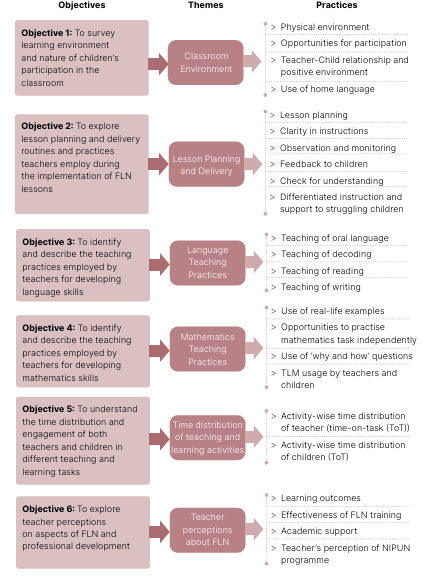
With this focus on teaching practices, Language and Learning Foundation (LLF), New Delhi, conceptualized the Teaching and Learning Practices Survey (TLPS). The Survey included 21 indicators under four themes. These included: 1) classroom management; 2) lesson planning and delivery; 3) language teaching, and; 4) mathematics teaching. The research objectives were mapped to the themes, which directed the shortlisting of indicators. The mapping of objectives with themes can be clearly seen in Figure 1.
These indicators were rated on a 4-point scale in a classroom observation tool during 40 minutes of silently observing the teacher teaching language or math. Besides a classroom observation tool, the Survey tried to include teachers’ voices about their beliefs and knowledge in the form of a teacher questionnaire. Another important tool in the Survey was to record the time distribution of different teacher and student activities.
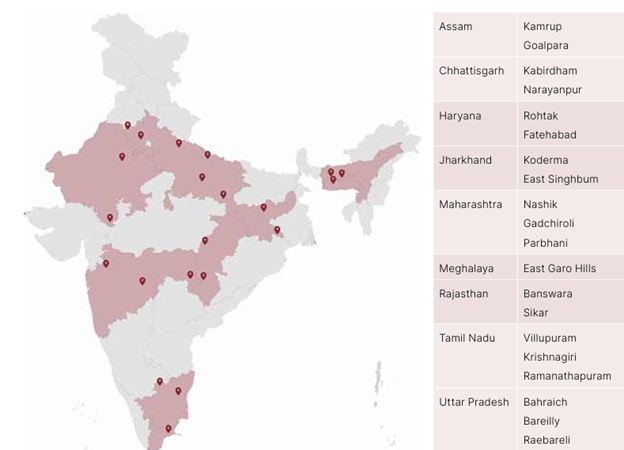
States covered in TLPS 2025
In the academic year 2024-25, TLPS team observed 1,050 classrooms in 21 districts across nine states. These states covered the length and breadth of the country, namely—Assam, Chhattisgarh, Haryana, Jharkhand, Maharashtra, Meghalaya, Rajasthan, Tamil Nadu and Uttar Pradesh. The coverage of the survey, including the districts, is also shared in the map below. These nine states were covered with partnerships between Language and Learning Foundation and four organizations—Centre for Microfinance (CmF), Madhi Foundation, QUEST and Vikramshila Resource Education Society (VERS). Tata Trusts supported this first cycle of the Survey.
What did we find?
In the light of the immediacy of classroom-level findings, some key findings are discussed here.
Print awareness: Most classrooms have become print-rich. However, often the print-rich materials are not displayed at the children’s eye-level. It is commonly known and accepted that print-awareness is enriched through print-rich classrooms. Print has meaning and content that is verbally shared can be written too.
Print-awareness can be further enriched if print materials such as labels, poem posters, posters for conversations, etc., are not seen as mere cosmetic applications in the class and are connected to the lessons being taught. Their placement at children’s eye level encourages children to better connect with the print-rich material.
Use of the learners’ home language(s): More than 70% of the teachers know the children’s home language(s). However, less than 10% of the teachers use them consistently. Home language is the language spoken in the child’s home. There can be more than one home language. Most children have a different home language than the medium of instruction. Some have regional differences or community-specific vocabularies which differ from the medium of instruction.
If the medium of instruction is different from the majority of the children’s home languages in early grades, and teaching continues in only the school language, then comprehension, engagement and connection with the learning objective is limited. Using home language in early grades supports children’s active engagement and comprehension of concepts. This can help them in further academic achievement in the long run. In most states, teachers reported knowing the children’s home language. Yet, we have a long way to go when it comes to teachers using the home language deliberately and strategically to support children’s comprehension and participation in classrooms.
The reality of multi-grade classrooms: Two-thirds of the surveyed classrooms are multi-grade. This impacts effectiveness in teaching and the children’s engagement. Multi-grade situations divide the teachers’ attention, engagement, and teaching time with one grade. They must divide their time between the different grades they are responsible for. This needs different kinds of planning and inputs.
We have been planning and training according to mono-grade situations. This is a situation where one teacher teaches and is responsible for one grade. We must address this challenge in multiple ways. At the macro level, it is necessary for the system/states to undertake a gap analysis and accordingly deploy teachers efficiently as per the state’s need. And at the micro level, it is essential to plan training, create curriculum, and monitor and support teachers based on the multi-grade situations.
Inadequate conceptual learning: Language teaching sessions are predominantly about copying tasks and choral repetition/responses. In classrooms where children are given opportunities to read independently, not more than 10% of the teachers were observed supporting them with feedback or correction. Mathematics teaching is also heavily teacher-led. Teachers and children were observed to sometimes use TLMs in around 25% of the classrooms. Teachers were seen using ‘why and how’ questions only in 4% of the observed math classrooms.
Accepting choral responses (children respond in a group collectively) and/or repetition (children repeat after the teacher or a child, together) limits children’s opportunities to think, predict, infer, or question during discussions. Similarly, copying during writing tasks hinders children’s articulation of their own ideas, thoughts, and feelings in writing.
Open-ended questions and discussions support children’s understanding and learning of language and math concepts. Using ‘why and how’ questions helps teachers to confirm a child’s conceptual clarity and the steps used to reach the solution. Math concepts and processes are also better explained with the use of TLMs. It is imperative for teachers to provide opportunities to children to practice with TLMs.
Inadequate learner-centricity: Lastly, about 66% of teaching time was spent on teacher-centered activities and just 15% on learner-centered activities. Time-on-task (ToT) is the distribution of time between teacher and children for actively engaging in teaching and learning time. It is usually less than the allocated teaching time (one period with an average of 35-45 mins). A higher ToT of children requires better planning and execution of class management by the teacher. This ensures children’s active engagement, which is one of the important components for enabling a learning environment.
Many studies and evidence have shown that teaching at appropriate level requires minute observation and the strategic use of classroom teaching time. The teachers also need to provide constructive feedback for children to actively engage in learning. It is, therefore, essential that teachers’ on-task time is appropriately balanced between learning and learner-centered activities.
What lies ahead?
Pedagogical strategies and classroom management practices require internalizing new methods and sufficient practice time. Inputs for building teachers’ subject-specific expertise have been a consistent part of the agenda of state-level training for the last few years. However, there is a strong need for reflection if these inputs are not translated in classroom teaching.
In many states, the cascade model takes more than a quarter of the year to complete the entire training cycle for an academic year. This is because in the cascade model, trainers like state-resource groups or key resource groups are initially trained to train those at the district level. The latter then train the block-level mentors/trainers, who eventually train the teachers.
In many training programs, there is a lack of demonstration-based practice that might support teachers in adopting the strategies during classroom teaching. In addition to adequate training, there is also a need to support teachers through academic coaching and focused mentoring. Such support can efficiently improve the teaching practices through demonstrations, constructive feedback, and consistent handholding.
The reform required in classroom teaching is not a lonely fight. Teachers must be supported by all the stakeholders through capacity-building, academic monitoring, and consistent coaching at the right level for a meaningful change in teaching practices to take place. When system-level inputs join hands with school-level efforts, improvement in teaching practices is assured, which will consequently improve students’ learning outcomes.

Related Articles

By | September 22, 2025
No approved comments yet. Be the first to comment!