
Finding and cultivating spaces for educational innovations
This is the third part of a conversation between Yamini Aiyar and Rahul Mukhopadhyay. It takes Aiyar’s recent book 'Lessons in State Capacity from Delhi's Schools' as a starting point. In this part of the conversation, drawing on Delhi’s school reforms, she reflects on how civil society organizations and education bureaucracies can collaborate more effectively. She highlights the challenges of translating reform ideas into practice and argues for cultivating 'interstitial spaces' of dialogue, trust, and sustained engagement to enable meaningful institutional change.
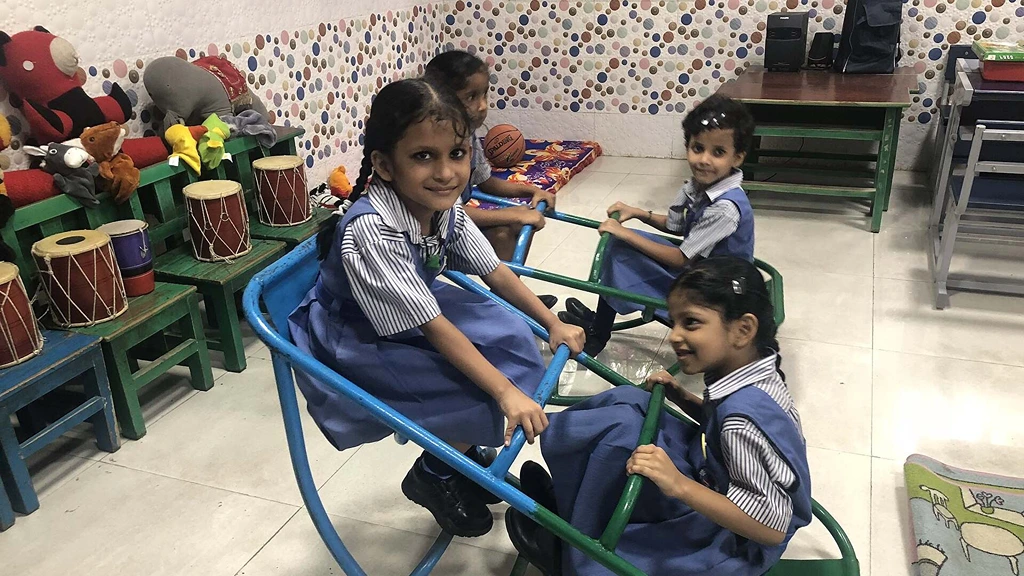
Happiness Class Activity in a Delhi Government School
Photo credit: Wikimedia Commons/Government of NCT of Delhi
Rahul Mukhopadhyay: Coming back to your own experiences. Do you think you can suggest spaces where there can be intersections of the deliberative forms of culture between the work of civil society organizations and those of the education bureaucracy? If so, how can these spaces be actively worked upon by the CSOs?
Yamini Aiyar: Thanks, that’s a great question. Let me try and answer that first with an example of what we observed in Delhi. When the new government came to power in 2015, they embarked on a fairly serious effort to try and improve and reform the school system. Of course, because of the peculiarities of Delhi, they were largely dealing at the time with upper primary and secondary schools. So, the focus of what we were looking at was largely classes 6 to 8.
And a large number of civil society organizations were brought in. As it now happens quite routinely, an exchange of ideas and of collective thinking and active implementation, is very much part and parcel now of how change is taking place in India. There is a lot of coming together of CSOs and the bureaucracy. I would say this is perhaps more at the bureaucratic level than at the level of politics.
The party that had come to power in Delhi in 2015 still had some of its movement culture with it. Those days, a lot of the assumptions were that you had to shift how the top end of the bureaucracy communicates, that is, changing when they would go to do their meetings with schoolteachers, and so on. They would use motivational language, a more deliberative, norms-oriented communication structure, and CSOs were very much part of that.
Rahul Mukhopadhyay: But how did this translate into practice on the ground?
Yamini Aiyar: The system is of course embedded in operating on the structures that it already knows, right? I remember once we were in a training session. The minister and some of his key colleagues (including some civil society actors) came and gave the opening plenary where lots of wonderful things were said. And then, as you do when you are a minister, you leave and all the details are to be worked out in the interactions between the officers.
So, they left. But because we were documenting and observing this whole thing, we stayed. And as soon as the minister and the senior officers left, there were two reactions. One was skepticism, “Ye log aate hai, aisa bahut bolte hai, badal jaate hai” (They come, they say a lot, then things change). But the other reaction, which was trying to take it seriously, did not know how to convert these grand ideas into anything that was actionable.
So, for example, early on, mega-PTMs (parents-teacher meetings) were to be organized. The purpose of this mega-PTMs was to bring parents, students, and teachers together into a collective dialogue about education, about learning. This was not discussing the children’s report cards and sharing their academic performance with the parents.
The PTM would start with a big motivational speech. And then, on the radio, in Delhi, a very senior member of the cabinet would come on to announce that “Aisa ek mega-PTM ho raha hai’ (Such a mega-PTM is happening). A letter was sent to parents and teachers about how this was to be about creating a conducive environment for making learning more enjoyable and bringing parents into the dialogue.
But at the school level, the teachers were tasked with implementing this mega-PTM. And, there is no concept of implementing if you have not got an order. So, the bureaucracy had to create an order, in order for the schools to be able to organize the PTM. And how do you create an order around these nice fuzzy ideas? The order, thus, became something about tea and snacks, school assemblies, and report card distribution, etc. The teachers ended up using a checklist to tick off the items in the order and sent it up the hierarchy.
Now, at one level, you could argue that this was a good first step. But at another level, it is that translation (of the order at the implementation level) which becomes hard because you are not operating in a vacuum. Even in many of the trainings that we observe, where CSOs were conducting the trainings, there would be constant dialoguing and back and forth. The bureaucrats would listen and shrug their shoulders and say to each other, “This is fine inside the training centre. But our daily lives are complicated because we have to do all these other things and listen to orders. So, this is not really helpful in our daily lives.” So, this is how the cultures sometimes clash.
Rahul Mukhopadhyay: But does this mean that there are no rooms to maneuver in?
Yamini Aiyar: I do believe that the way to think about change is through the idea of interstitial spaces. There are always spaces and opportunities within various systems that are embedded in a particular way of behaving, which we need to identify and slowly try and prise open. For me, one of the big things that worked in Delhi was a constant presence (or a possibility of a constant presence) of some of the key reform actors in the school. And that constant presence meant there was communication. However, that may be peculiar to Delhi because it is small, and it is easy to go up and down.
So, there were disagreements over reform ideas. Many were very skeptical, and rightly so. They had a lot of questions that they were asking. However, there was someone from among the key reform actors around to discuss things with. There were also spaces for dialogues. A part of the dialogues was this cadre of mentor teachers. They went off to Finland, they went off to Singapore, they went to Cambridge, on exposure visits arranged by the incumbent Government of Delhi and the Education Department. However, the government was trying to create its own ambassadors.
This cadre of mentor teachers was sometimes considered to be slightly politicized. But on the other hand, another way of looking at it is that you created this cadre of people with whom there could be a collective understanding around the reform ideas, and these people then were the ones who were to engage with the other teachers. And overtime, even the training sites started becoming a little bit more dialogic than the usual way of just feeding information and not eliciting feedback.
I think we must pay a lot of attention to the minutiae of how the bureaucracy behaves and identify within those sites where potentially some small wins will be made to collectively build. Think of it as a patchwork, that you slowly, slowly, slowly take all these pieces, and eventually you will get this very beautiful multi-coloured piece of cloth, which is dynamic and appealing.

Related Articles
By | April 1, 2025
No approved comments yet. Be the first to comment!