
Reflections from an inclusive nature education program with children with disabilities
The author reflects on the challenges and possibilities of inclusive pedagogy through a bird-based nature education program for children with diverse disabilities. The article highlights how thoughtful design, flexibility, and multiple pathways to participation can make environmental learning accessible and meaningful for all children.
Introduction
There is something deceptively simple about teaching children about birds. They are everywhere around us. They fly across our balconies, sit on electric wires, call from trees and search for food in places we pass every day. For children, they can be a natural entry point into questions about animals, habitats, food, movement and the environment.
But what happens when the children in the room have very different ways of seeing, hearing, communicating, moving and making sense of the world?
That was the question we encountered during the Bird Learning and Nature Connection Program, a collaboration between ASTHA and Ecovita Foundation. Over January and February 2026, 35 children from ASTHA’s community centres in Majdoor Camp and Nand Nagri participated in an eight-module program. It combined centre-based learning with visits to Lodhi Garden and the Okhla Bird Sanctuary. The group included children with autism, cerebral palsy, intellectual disabilities, hearing and speech impairments, and other developmental disabilities.
The program was designed as an environmental education initiative. However, for those of us involved in the work, it became equally an exercise in understanding inclusive education itself. The challenge was not simply how to make a bird program accessible to children with disabilities. It was how to teach a common subject to a group of children whose needs and ways of participating could be substantially different, without either excluding some children or reducing the learning experience for everyone.
Designing the program
In the first few sessions, it became clear that extended verbal explanations were not particularly effective for many of the children. Abstract concepts were difficult to retain, attention often dropped, and lengthy instructions could quickly lead to disengagement. The response was not to remove the concepts from the program, but to change the way they were introduced: shorter instructions, repeated prompts, gestures, visual materials, and objects that children could actually handle became much more important. Even that, however, did not produce one universal solution.
PowerPoint presentations, for example, were found to be ineffective for many participants. This was partly because it was difficult for some children to maintain attention on a distant screen. Additionally, low-vision participants could not engage with the material easily. Large, printed flashcards worked better because the images could be brought close to the children.
But visual learning itself could not be the complete answer. Children with hearing impairments required parallel support through sign language and other forms of communication. Movement-based activities created enthusiasm, but children with physical limitations could not always perform the movements themselves. Listening to bird calls was engaging for some children. However, naturally it was not an accessible route into learning for children with hearing impairments.
This is where inclusive education becomes considerably more complicated than the language of ‘adaptation’ sometimes suggests.
Accessibility does not mean making the content easier
One of the tensions we encountered was that the same adaptation could help one child while limiting another.
When explanations were simplified for children who needed short, concrete instructions, there was a risk of making the material insufficiently challenging for children with stronger cognitive abilities but significant physical disabilities. Conversely, when the program introduced more complex ideas such as migration, adaptation and survival, some children disengaged. This was because the concepts required a level of abstraction that was difficult for them to access.
This is a useful distinction because accessibility is sometimes understood as simplification. The assumption is that if something is difficult, the inclusive response is to make it easier. However, that can become another form of exclusion. A child should not lose access to interesting or intellectually meaningful content simply because they communicate or learn differently. The challenge is to preserve the substance of the idea while finding different ways of entering it.
The program, therefore, relied on multiple forms of engagement around the same concepts. A discussion about nests could become an exercise in collecting twigs and constructing one. Bird behavior could be explored through movement and role play. Beaks and food could be understood through matching activities. Feathers could be explored through touch. Bird observation could happen through binoculars, drawing, pointing, discussion or simply sustained looking.
The learning objective remained, but the route toward it changed. That may be one of the more useful ways to think about inclusive pedagogy—not as producing a separate lesson for every child, but as designing enough entry points into a common experience.
The lesson plan was important, but it was never the whole plan
Inclusive teaching requires planning. However, good planning cannot anticipate everything that will happen once children are actually in the room. The program had detailed lesson plans, prepared materials, visual supports, tactile resources, and structured activities. The sessions followed a progression, introducing, and reinforcing ideas around bird behavior, habitats, food, nesting, adaptation and care.
Yet the facilitators also had to respond to what was happening in front of them. A child’s attention, mood, sensory threshold or willingness to participate could change from one day to another. Some children needed more individual prompting. Others needed more time. Some activities had to be modified while they were taking place.
This meant that the program had to operate simultaneously at two levels. There had to be enough structure for children to know what was happening. At the same time, the educators had to remain sufficiently flexible to change the activity when the group required it. That is not easy to capture in a curriculum document. It depends considerably on the judgment of the people facilitating the program.
Some of the most useful adaptations were remarkably ordinary
There is a tendency in disability programming to associate innovation with specialized equipment or expensive technology. Our experience was rather different. Some of the most effective changes were quite ordinary: bringing a picture closer to the child, reducing the number of words in an instruction, repeating an activity, giving a child something tangible to hold, allowing more time, or replacing a worksheet with an activity involving natural materials.
Craft activities were particularly effective. Making birds, building nests, creating binoculars and developing a personal ‘My Bird World’ habitat often held children’s attention for substantially longer than conventional classroom activities. There was a physical object at the center of the activity. However, there was also a sense of ownership. The children were, after all, making something that belonged to them.
Nature itself is not automatically inclusive
The field visits brought another dimension to the program.
For some children, the visits to Lodhi Garden and the Okhla Bird Sanctuary represented their first immersive experience of a natural environment of this kind. The excitement was evident, and outdoor sessions generally produced strong engagement. At the same time, the physical environment was not uniformly accessible. There were areas where wheelchair access was limited. The team had to work deliberately to ensure that children with mobility limitations were not left behind.
This is worth stating because there is sometimes an assumption that nature itself is inherently therapeutic, liberating, or inclusive. A park can be beautiful and inaccessible at the same time. A bird-watching activity can be carefully designed and nevertheless become inaccessible if the only meaningful activity depends on hearing or vision. The responsibility, therefore, cannot be placed on the child to ‘adapt’ to nature. If we want children with disabilities to have meaningful access to natural spaces, we have to think about the spaces themselves, the journey to them and the support required once children arrive.
Perhaps the most important evidence came after the sessions
Some of the strongest indications that the program had mattered did not come from the sessions themselves.
They came from what children began doing afterwards. Parents reported that children started noticing birds on everyday journeys, pointing toward birds and trees, photographing birds from balconies and becoming interested in insects and plants. One parent described how her daughter had become so interested in birds that she spent time photographing those visiting the family balcony. Another described a child pointing out every bird they encountered when they went outside.
These observations are important precisely because they are ordinary. The objective of a nature education program does not have to be that a child can reproduce a list of bird names at the end of eight modules. A more meaningful outcome may be that the child begins to notice something that they previously passed without seeing.
One eight-year-old girl with autism began using words including ‘chidiya’, ‘chonch’ and ‘khaana’ in connection with the program.
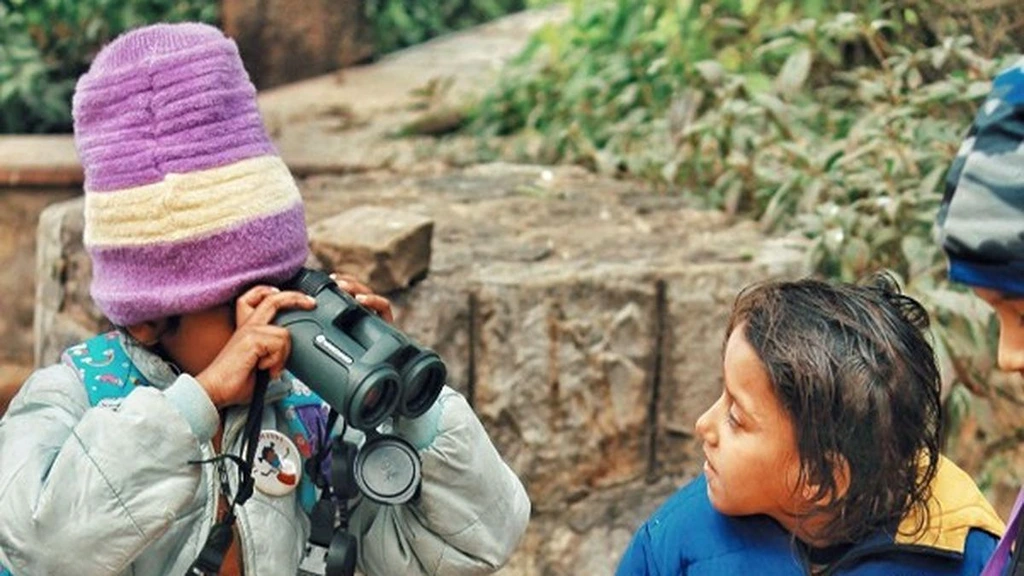
There were also changes in how children interacted with one another. Educators observed children pointing out birds and sounds to peers, sharing discoveries and helping one another during activities. On the field visits, two children, Dipali and Sonakshi, (photograph given below) developed a particularly visible pattern of supporting and guiding each other.
But these observations do challenge the way we think about learning outcomes. For some children, learning may be visible not in a written answer but in a new word or a gesture toward something interesting. It may also involve an attempt to share an observation with another child, or the fact that they have begun looking at the world around them differently.
Rakhi and Shaad show the way
A 14-year-old girl with cerebral palsy, joined ASTHA in 2022. She was initially very shy and found it difficult to participate with other children. However, group activities gradually helped her become more comfortable, communicate and build friendships. During the bird-watching program, the team consciously adapted activities so that she could participate using her own strengths and abilities.
At the centre, Rakhi explored birds through photographs and sounds. She also took part in hands-on activities such as making a bird’s nest with clay, dry sticks, grass, and paper, and making binoculars from cardboard. These activities gave her opportunities to use her hands, make choices, and work alongside other children, with support from her mother and peers when needed.
The learning was then taken outdoors through visits to Lodhi Garden and the Okhla Bird Sanctuary, where Rakhi could see birds in their natural surroundings and listen to their calls. To support her participation while moving around, a lightweight tray was added to her wheelchair so that she could carry and access bird flashcards and other learning materials independently.
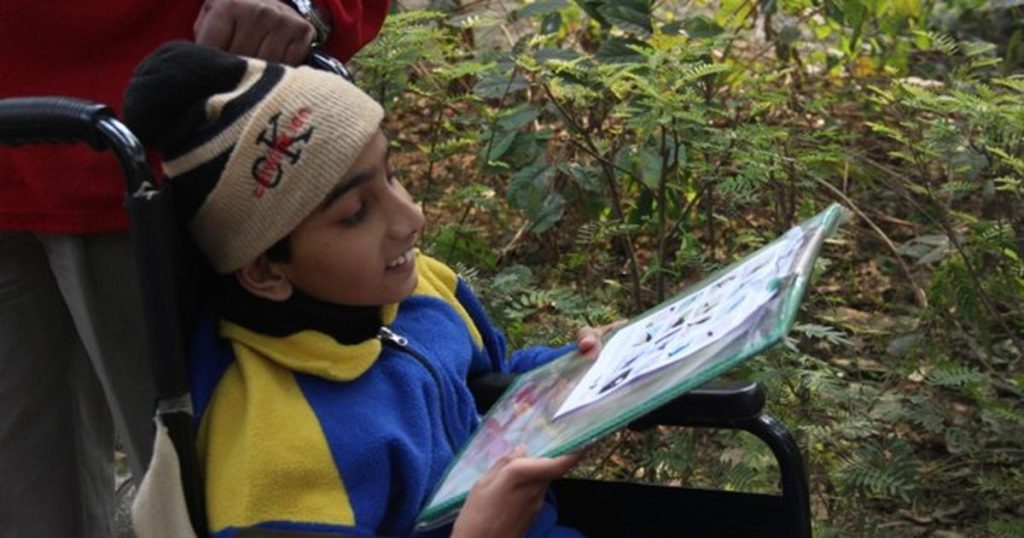
At Okhla, she worked with other children to make a nest and responded to questions by pointing to familiar birds on flashcards and using gestures. She also began using new words such as ‘chidiya,’ ‘dana,’ ‘pani,’ ‘kaha’ and ‘khana’. Rakhi’s experience demonstrated that inclusion in outdoor and multisensory learning does not necessarily require a separate activity for a child with a disability. Simple adaptations to materials, mobility, communication and the way an activity is structured can enable the child to see, hear, touch, make, move, communicate, and participate alongside their peers.
Six-year-old Shaad is autistic and initially preferred to stay away from group activities. During the eight-session bird-watching program, he connected particularly strongly with bird sounds, pictures, and hands-on activities. He began imitating bird calls in a rhythm, made a bird using clay and dough, and explored grains and seeds while learning about what different birds eat.
During outdoor sessions, Shaad also participated in feeding and giving water to birds. Gradually, Shaad began sitting with the other children and joining group activities for longer. For us, his experience was a reminder that learning does not look the same for every child. Some children may respond to a picture, others to a sound, movement or hands-on activity. When children are given different ways to engage, participation can begin to emerge in unexpected ways.
As Chinki, Assistant Manager and Educator from ASTHA shares, “Initially, Shaad would prefer to stay away from the group. But when we introduced bird sounds and hands-on activities, he began finding his own way to participate. Seeing him sit with the other children, imitate the sounds and join the activities was a small but meaningful change.”
Inclusion is a design problem as much as a disability problem
The most lasting lesson for us was not about birds. It was about where we locate the problem. When a child does not participate, our first instinct can be to ask what is wrong with the child: Do they have limited attention? Do they have difficulty communicating? Can they not understand the concept?
The experience of this program encouraged us to ask a different question: What is it about the way we have designed the experience that may be preventing participation? Sometimes the answer will still involve a support that an individual needs. A child may require one-to-one assistance, communication support or physical help. But that does not mean the program itself is beyond redesign.
The more inclusive approach is to assume difference at the point of design. That means planning for different forms of communication, different sensory experiences, different physical capacities and different levels of cognitive engagement before the first child walks into the room. It also means accepting that a well-designed program will still need to change once it meets real children.
For ASTHA, perhaps that is the most useful lesson from the bird program. Inclusion is not achieved when we have successfully modified a standard activity for a child with a disability. It is achieved when difference has been considered from the beginning, when there are multiple ways to participate, and when educators have the knowledge and flexibility to recognize participation even when it does not look like what they originally expected.
We began with a program about birds. What it gave us was a more demanding understanding of inclusive education. The question is not whether every child can fit into the experience we have designed, but whether we have designed an experience wide enough to accommodate the children who are actually there.
Note: The author is grateful to Divita Jain and the Ecovita Foundation for their collaboration and support for this initiative.
No approved comments yet. Be the first to comment!