
Nature learning for all: an ode
In her context-setting article, Vena Kapoor argues for making nature education central to learning/living processes, even in settings where we think there is very little of ‘nature’ to be found. She makes a case for engaging with all the living beings around us, ranging from the tiny but ubiquitous ants and spiders in our homes to the majestic trees in the neighborhood, so that we know, learn, and feel deeply for nature.
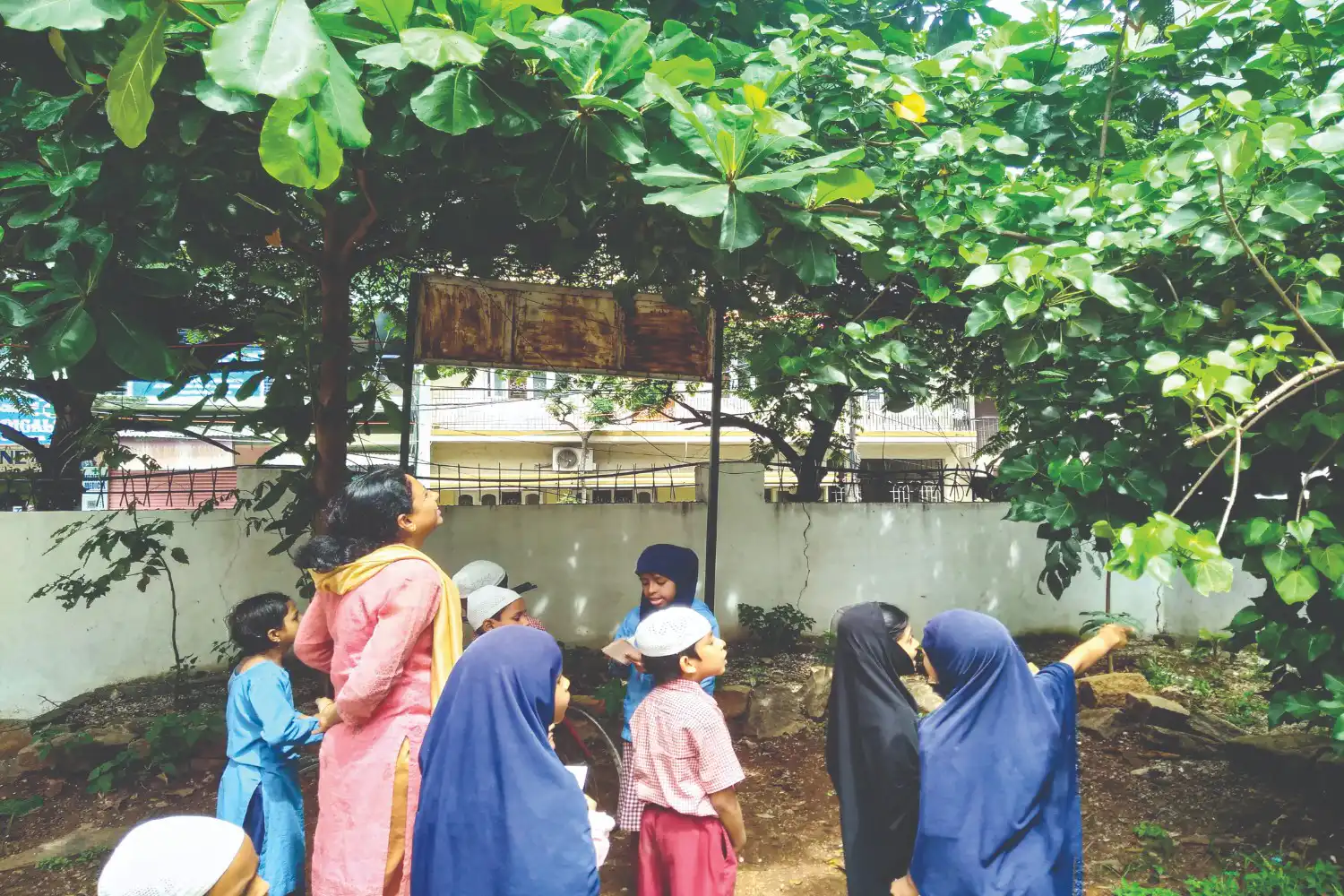
Is it easier or more difficult to write about a topic that you live for, love deeply, and engage all your usable senses day in and out? The nature part comes more easily, I think; the education part often gives me sleepless nights. For all of us working in the field of education, the prefix before this word changes—art, sport, science, math, basic literacy, theater, nature… We love the work with a stubborn passion and conviction.
Along with this work, we try to navigate the challenges of funding, logistics, bureaucracy, and the disinterest (most often because of being overburdened) of key stakeholders that invariably get thrown at us. Yet, we make sure we keep our deep belief and enthusiasm for our work intact, fiercely protecting it to make sure that the people in this journey, along with us, and those who come after, will not flounder or waver, and always see the value that our engagement and interventions, however small, bring.
A few weeks back, one evening, I was pacing up and down on a friend’s terrace. It was almost dusk. As I looked down from the 5th floor onto the chock-a-block houses and buildings of a residential locality in Bengaluru, I also saw hundreds of old, new, electricity, internet and cable TV wires, and cables creating an impossibly untidy crisscrossed maze above the roads and between the trees and other vegetation.
I stared at the wires, thinking about how horribly unpleasant they looked alongside the lovely tree filled lanes. “How difficult it must be for them to constantly have to maneuver this deadly maze,” my friend said softly, and a bit sad. My quizzical expression lasted for a few seconds, and then it struck me; he was talking about the bats that we were seeing flitting through and above the trees.
I remember feeling fleetingly thankful, at that moment, to be surrounded by friends and colleagues who are also deeply empathetic to the natural world that lives alongside us, the only reminder that keeps me going every day in a world full of loss and ecological catastrophe. These are animals who have every right to live full and free lives on this planet, just like we demand. However, we almost never consider them in our human-constructed planning of space and fickle comforts.
And then I looked up. Hundreds of fruit bats were flying gloriously overhead with determined purpose, and along with them, tens of the smaller insectivorous microbats flitted around almost mischievously, a bit lower. I counted them as they flew overhead, and in four minutes, I counted more than 70. Such a fun exercise that was, and also so marvelous!
Why had I not done this growing up? I was fortunate to have had lovely open terraces in many of the rented houses I grew up in. Would I have looked up at the skies, and marveled, and been awed about the bats and birds that flew overhead at dusk, starting out on their hunts or heading to their secret roosting sites, if an adult at home or at school had pointed or guided me to do this? I’d like to believe so, because much later in my early 20’s, that was how I was finally introduced to nature around me.
I remember always loving animals and plants, and was a fierce defender and protector of them—I had managed to gain that reputation even before I was 10. However, I had no idea how to channel this innate love into wonder, curiosity, or exploration. I poured and reveled over books, magazines, and documentaries that featured the natural world and its denizens, featuring jaw-dropping animals, plants, birds, and habitats from faraway lands.
What I did not know at that time was that different birds and squirrels would have been flitting just outside my own windows at home or school, and numerous insects and spiders would have been hiding in plain sight, leading amusing, bizarre lives just around me.
This realization continues to be a source of sadness and disappointment—I had lost so many years of not truly engaging with nature around me. Growing up in a metropolitan city, I did not know of the option or possibility of unfettered explorations outdoors, or having an ‘interested-in-nature’ family member, or a social circle of nature explorers who many of my friends and colleagues seemed to have as a child or teenager.
I make up for these lost times with a vengeance now, and try and use every opportunity to point willing and unwilling adults and children to the numerous birds, millipedes, ants, spiders, beetles, assassin bugs, bagworm moths, silverfish, squirrels, fungi, lichen, parasitic plants, and herbs that seem to want to continue living alongside us, even in our most inhospitable, concrete, and smog-filled cityscapes and habitations.
We have examples from research projects in the West highlighting how children with more nature near their homes exhibit less psychological distress, and that access to nature as a buffering or interactive effect seems to moderate the impact of stressful life events on the self-worth of children.
At least one study has demonstrated that when urban children aged 9–12 were asked to make a map or drawing of all their favorite places, almost 96% of the submissions were representations of wild outdoor places. Carefully designed studies are showing us that, given a choice, most children prefer to spend time in natural settings outdoors, and a disconnect from the same seems to negatively affect their well-being.
While these studies help us reinforce and reaffirm why we need to take nature education and experiential immersion in nature as part of our everyday lives and interactions, what does this mean for educators like us? How do we take those next steps of allowing people to see the immense value of engaging and being in love with the natural world and all its inhabitants? Moreover, how can we do this with kindness, empathy, and sensitivity that captures everyone’s socioeconomic reality and lived experiences, along with the reality of the competing onslaught of insipid rote learning and capitalist market forces?
As educationists, we know (like in every subject that we are engaged in) that hearing and learning new terms and concepts alone may not necessarily mean understanding them. Moreover, cognitive understanding does not automatically lead to strong attitudes. Feelings and emotions (the affective domain) have been shown to be crucial in understanding how children think and learn. Even a cursory scan through the textbooks that schoolteachers and educators rely on and use as tools to learn and teach highlights how devoid they are of the affective domains.
Another study, situated in Mexico and the UK, demonstrated that using hands-on activities to experience and learn a new environmental or nature term is more likely to result in understanding of concepts and connections in nature, compared to only using a textbook by a teacher-educator. How can we, therefore, push ourselves to teach and learn in more enjoyable ways, using different tools, experiences, and keeping abreast with research findings from across the world and in different disciplines that may be relevant to our work? Our engagement and teaching needs to be creative, interesting, inclusive, equitable, and learner-centric—that which will allow for educators and learners to develop, understand, appreciate, and feel a sense of wonder and amazement—the facets of attitude, skills, values, and knowledge for nature and for the environment.
We have a huge advantage in that nature is all around us, irrespective of where we are physically. If we look just a little closer, shutting out the busy bustling noisy things around us, there will always be something to discover and marvel at arm’s distance or closer! Climbers, shrubs, and wayside ‘weeds’ will be home to numerous insects and spiders building their homes or finding things to hunt and feed on; cracks on the curbs and walls will have small fig plants peeking out, as if in defiance; ceilings and corners of rooms will have the common cellar spiders doing their routine push-up exercises; wasps and bees will be hovering around, looking for little holes and gaps in our human-made structures to encash their paralyzed food cache for their young ones; and of course, there are always the sometimes soothing and hilarious and sometimes raucous and annoying calls of birds, crickets, frogs, and toads to remind us that other beings, that are very much part of our physical spaces, also communicate with each other!
As Poornima and Abhisheka, in their interview with us for this issue, and Yuvan, in his latest article, remind us, nature and nature learning can also be a wonderful leveller that can cut across class, caste, and gender. There are numerous examples from the natural world where our often normalized, accepted, human-defined, and patriarchal gaze and actions are completely and gloriously flipped; where accessible spaces and the use of them, the actions of turning rocks, scooping mud, and nurturing and planting seeds and saplings can potentially break down barriers, conversations, and acceptance—small acts of joy and rebellion that we can all collectively marvel at and be delighted by, when that wriggly earthworm gets dislodged with our collective churning, scooping of earth under our collective feet. We cannot afford to have millions of young people growing up (like I and many others did, of my generation and before) disconnected, uninterested, and unaware of the natural world—a world that is so full of delight, wonder, amazement, discovery, awe, and so deeply intrinsic to our physical, spiritual, and mental lives.
This issue of Samuhik Pahal was put together and worked on with the same joy and happiness that we experience and throw around in the nature education work that we do and love. We wanted to draw the attention of the educator to the possibilities of using and engaging with nature as a powerful and heartwarming learning/pedagogical approach and tool in all the education work each of us engage in. We hope that you, the reader-educator, will be awed and inspired by the insights, approaches, and passion that the nature educators we spoke to, wrote, and shared their ideas and tools with us.
Do immerse yourselves in their stories and insights, share your own, and engage and collaborate with each other when possible. We certainly learned many new, exciting things from this listening, curating, and collaborating. We go forward with a renewed, urgent energy and hope to make nature and nature learning an important part of our being, a part of each of our life journeys, an important perception of ourselves and our vocabularies, a part of our daily rituals, of our stories, our imagination, our identities, our love, and as our obligation. We go forward with a deep hope and wish that we would pass this on to the children, young adults, and communities we teach and work with. Do join us in this journey, and may our tribe grow!

Related Articles
By | July 4, 2024
No approved comments yet. Be the first to comment!