
Learning together: trust, trials, and transformation
In this article, the author reflects on efforts to strengthen early childhood education in Anganwadis. For this, she draws upon her organization's three-year Shakti program in Pune. This initiative focused on trust-building, sustained mentoring, parental engagement, and contextualized support. The piece highlights the value of relationships, flexibility, and holistic learning in creating lasting change.

BELIEF recently completed the Shakti program, an initiative that aimed to strengthen early childhood education (ECE) in Pune. This three-year project, started in 2023, aimed at improving ECE in Anganwadis, the government preschools run by the Integrated Child Development Scheme (ICDS). The Anganwadi worker provides six specialized services, i.e., supplementary nutrition, pre-school non-formal education, nutrition, and health education, immunization, health check-ups, and referral services. Among these, the preschool non-formal education often remains the weakest.
The ICDS, originally designed for rural areas, continues unchanged in urban contexts. This leaves Anganwadi workers to manage multiple responsibilities with meager honorariums. They lack training and handholding, appropriate Teaching Learning Material (TLM) and a learning space to share their needs and issues. Despite these realities, many institutions and corporates still promote digital Anganwadis and mobile applications as solutions. Meaningful education—rooted in experience and human connection—remains overlooked.
In Pune, we worked alongside Anganwadi workers who carry immense workloads and face inadequate training, scarce resources, and countless challenges. For us, this project became a vital chapter in both our organizational and personal growth. The journey was full of learning. We experimented, stumbled at times, and succeeded at others. In this piece, we share the reflections that emerged from these experiences.
BELIEF worked with the Anganwadis of Mundhwa, a former village on the outskirts of Pune, which has now been included in the city’s boundaries. A part of Mundhwa has now fully urbanized, while the rest remains as an underdeveloped slum settlement. Walking into the lanes of Mundhwa, as we cross the main road, one quickly notices how the streets and houses shrink in size. Small rooms pressed together, water drums lined outside, temporary bathrooms, and rangoli drawn right on the street— this is the everyday reality of the settlements. In these very lanes, Anganwadis operate out of tin sheds, parking spaces, or community halls. Just a few hundred meters away lies a world of plush international schools with modern facilities, while the Anganwadis here struggle even for basics.
Space constraints limit everything—from putting up charts to organizing level-based activities into the groups. Often, while a lesson is underway, nutrition supplies arrive, and children’s attention shifts instantly. The same space becomes a dining area, without proper facilities for washing hands or sanitation. As we began our work, the scale of challenges slowly revealed itself.

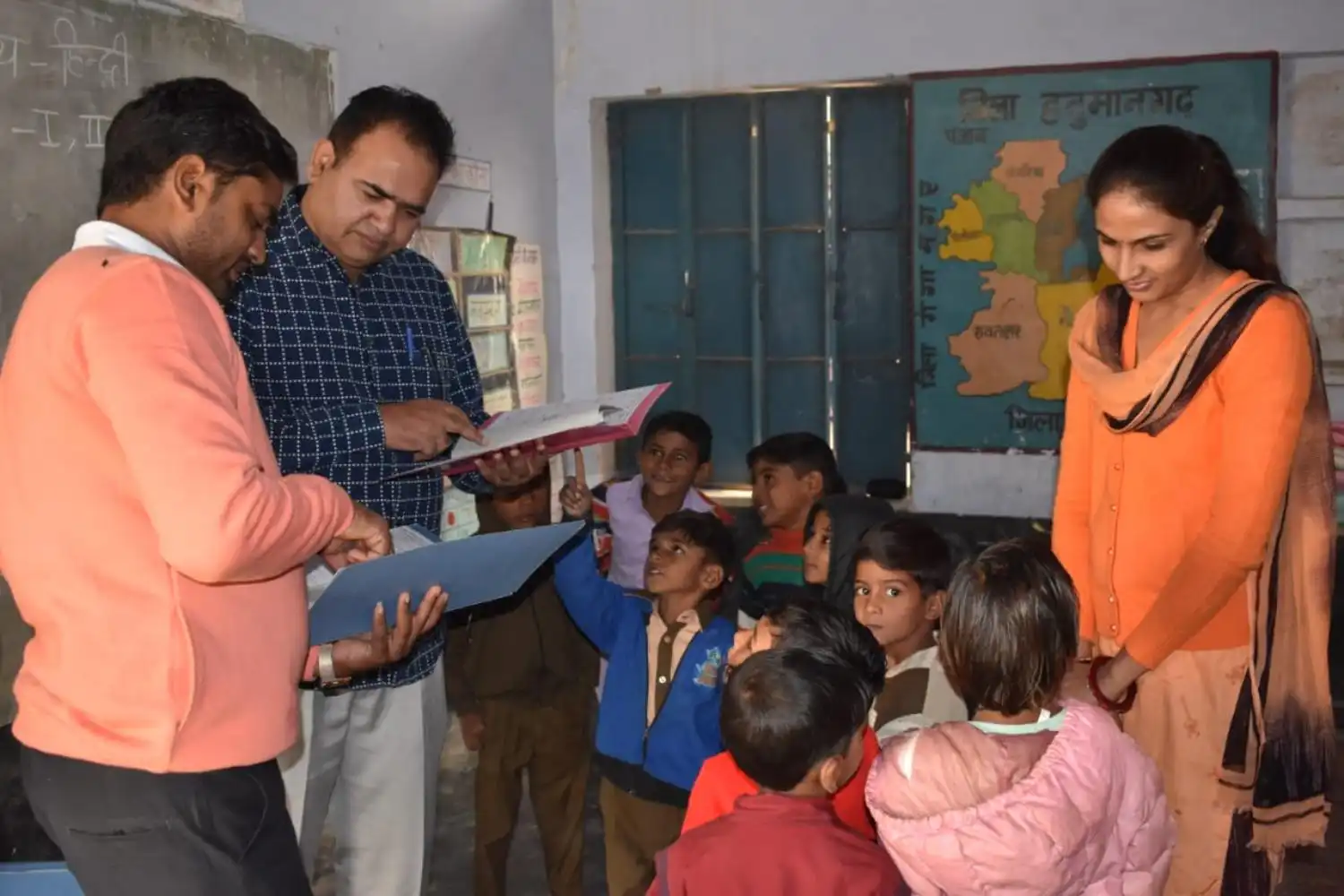
Gharoghari Balwikas book during the home visit
Photo credit: BELIEF
Another major challenge was the burden of governmental tasks. While performing their role, Anganwadi workers are often asked to play a bridging role between the government and the community. We saw them as frontline workers during the COVID-19 pandemic. Recently, we observed them as frontline workers for schemes like ‘Ladaki Bahin’ or ‘Pink e-Rickshaw’. Though they were expected to work after the Anganwadi is over, community members never followed the timings and used to come to the Anganwadi whenever they were free.
Facing all these operational challenges when Anganwadi workers actually started teaching, most of them seemed unsure about what exactly to teach because of lack of training. Parents, meanwhile, are drawn to private English-medium preschools. Those who cannot afford them send their children to Anganwadis. However, their expectations remain the same: “My child must learn English.” Holistic development is overlooked, replaced by demands for reading, writing, and homework.
Recognizing this reality, we deliberately kept the pace of ‘Shakti’ slow. We reminded ourselves constantly: “We are not chasing numbers; we want small but sustainable changes.” Before teaching, we listened to the workers’ challenges, their questions, and their personal struggles. Some Anganwadis had no helpers, some workers were differently abled, others had limited education, and many of them faced difficult family situations. We did not attempt to solve these issues directly. But we carried them in our minds as we worked.
Many times, Anganwadis did not open on time. There were no preparations for educational activities before the class started. We never complained about these issues to the government officers. Instead, our team kept visiting regularly, offering constructive feedback. Every day, the field coordinator spent three (3) hours in a single Anganwadi, observing each and everything happening in the classroom. This built trust. Workers began sharing their difficulties openly. Gradually, Anganwadis started opening on time, and the task-on-time increased.
We also recognized the often-underestimated role of Anganwadi helpers. Their contribution to early education is crucial, yet invisible. We organized focus group discussions (FGDs) and short training sessions for them. We discovered the mental stress they carried. So, we added stress management sessions. With consistent classroom support, some helpers began conducting sessions regularly. Coordination between workers and helpers improved, leading to more structured classroom practices.
To involve parents, BELIEF developed a ‘Gharoghari Balvikas’ kit—a book and set of materials for home learning. After field trials, we distributed it widely, oriented parents on its use, and followed up. Many found it helpful. It answered their questions about how to study with their children. Since the book was aligned to the curriculum, home activities complemented classroom learning. Parents began to see that education is not just reading and writing, and that learning can happen anywhere, even with everyday household materials.
Our team for this project was very small. Hence, some of the things we had planned could not be taken to completion. In addition, we experienced firsthand how changes in government systems, frequent transfers of officials, shifts in curriculum and its mode of delivery, and even prolonged strikes by Anganwadi workers all had a direct impact on the work. These realities became evident to us through the journey of Shakti.
Throughout this journey, we were able to build relationships with all stakeholders that were rooted in respect, closeness, care, and equality. ECE may not be rocket science. However, to us, it is just as important as rocket science. In this field, one cannot move forward by holding on to a single formula. Our approach needs to be tested repeatedly, and at times even changed. Allowing ourselves that flexibility makes it easier to achieve the larger purpose of the work.
In our work through Shakti, we consciously moved beyond the narrow emphasis on early reading and writing that dominates many grassroots experiments. Our approach placed equal importance on the wider experiences and holistic development that define early childhood. For us, school readiness was not limited to making a child read and write by the age of six. It was about enriching the child’s world of experiences in every possible way.
Toward the end of the project, we realized that the Anganwadis were functioning well, and workers were able to conduct the ECE sessions without our help. The measurable increase in task-on-time was noted. The ICDS officials were aware of the intervention and supportive toward the changes the project has brought in.
The micro-changes that our team tried to inculcate had slowly contributed to setting up the ECE culture in Anganwadis. We developed the monitoring and evaluation framework. Through this, we measured the impact throughout the project and at the end of the project. The findings were promising from increased attendance to improving the levels of foundational literacy and numeracy in children.
While doing this, we were fully aware that this approach worked in the urban context of Pune, with both its limitations and privileges as a metropolitan city. We recognize that the same model may not fit seamlessly into a tribal intervention like Nashik or migration-prone geographies such as Marathwada. What we have learned is the importance of making context-specific changes in the intervention and curriculum, while keeping ECE’s core intact. This flexibility is what makes our intervention distinctive—rooted in principles, yet adaptive to diverse realities.
ECE remains the most neglected section in the education structure in India. Funding is scarce, and when available, it often goes toward digitization, TV screens in classrooms, or uniforms for the children. AI-enabled Anganwadis are already being proposed. Yet the true foundation of education lies in sitting with children on the floor, and creating opportunities to learn and experience together. Through Shakti, this realization became even stronger for us. Our journey to deepen and expand this understanding continues.
Notes
- Ladki Bahin Yojana: The Mukhyamantri Majhi Ladki Bahin Yojana, commonly called as Ladaki Bahin (favorite sister) launched by the Maharashtra government on August 17, 2024, provides eligible women aged 21–60 with ₹1,500 per month to promote economic independence and empowerment. Anganwadi workers played a pivotal role in implementing this scheme. They identified and enrolled eligible beneficiaries, assisted with filling online application forms, and ensured smooth execution at the grassroots level. For each completed form, workers were promised an incentive of ₹50, recognizing their contribution to ensure the wider reach of the scheme.
- The Pink e-Rickshaw Scheme is a Maharashtra government initiative designed to empower women by providing electric rickshaws for self-employment. Anganwadi workers have played a key role in facilitating the scheme by assisting women beneficiaries with the application process, mobilizing eligible participants, and serving as an essential link between the government and the community.

Related Articles
By | April 29, 2026
By | April 29, 2026
No approved comments yet. Be the first to comment!