
The promise of citizen science
This article discusses the importance and possibilities of citizen science. It also alerts us to the ways in which it can help us make the doing of science broad-based and engaging.
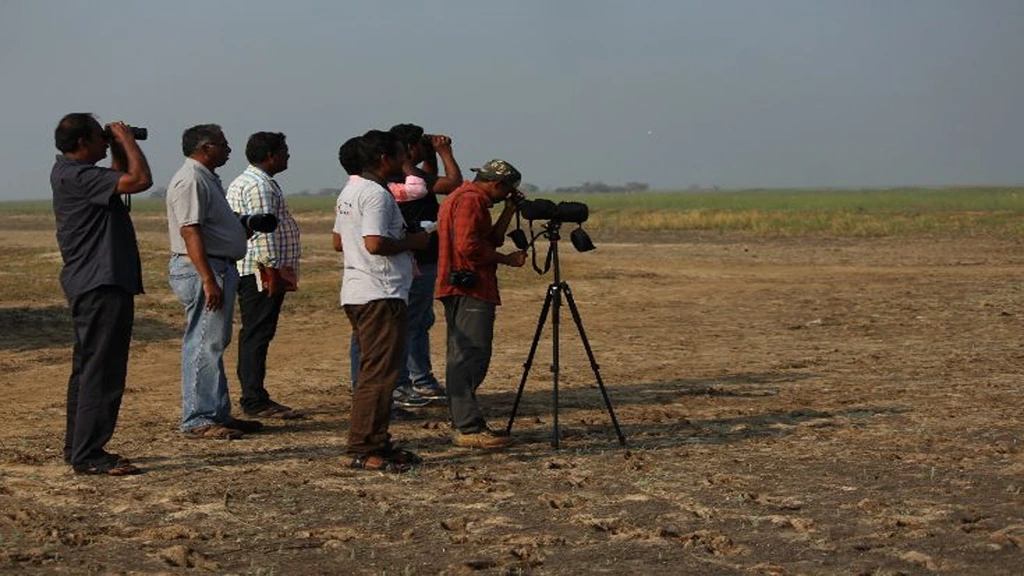
Photo credit: Wikimedia Commons/P Jeganathan
Modern Science as we know it today, emerged as an organized, programmatic, institutional phenomenon only in the last 150 years from an earlier, diffused phase of individual explorations by amateur scientists in Europe. In this transformation, the scientific paradigm explored many deep questions that ranged from the origins of the universe with telescopes in remote parts of the world, life in the deepest part of the oceans using submersibles, the smallest particles that make up atoms using giant particle colliders and the oldest rocks using microscopes and radioactive clocks. Institutional science allowed the space and funds for focused studies of this kind.
As the 20th century drew to a close, certain problems of scale emerged that boggled the most creative scientific minds. They started to question if only throwing increasing amounts of money, and technological and people resources could tackle the problem.
These involves problems like mapping all the innumerable space objects in the solar system and its neighborhood, observing the impact of climate change on plants simultaneously across different bioclimates of the world, and documenting the distribution and abundance of birds in different parts of the earth. In each of these areas of interest to the scientists were amateur communities of astronomers, plant enthusiasts and birdwatchers, who had specific and deep interests in observing and documenting areas of their interests in many ways. The scientists seized the opportunity presented by this diffused but committed network of volunteers and roped them into formal scientific endeavors.
They co-created frameworks of data gathering and reporting, quality control, data analysis and sharing with the amateur groups. In the process, over a period of time, emerged the phenomenon of ‘citizen science.’ Citizen science is an approach to research that partially delinks it from an institutional location. It widens it to a much larger community of participation by interested citizens across the globe. The problems addressed by this phenomenon are typically ones of scale that would have otherwise required heavy resource mobilization and infrastructure creation.
The power of citizen science lies in the amalgam of individual motivation to learn and participate in individual and group activities with a wider intent of generating quality scientific data at scale. As time has progressed, citizen science has begun spreading its wings to include people from non-mainstream backgrounds in rural areas and children in schools and community spaces. These groups participate in data generation, and sometimes even in analysis and publication.
Science, in this manner, has evolved to have participatory, community-oriented spaces of exploring natural phenomena. This has the potential to transform the manner in which science is perceived and experienced in an increasingly fractured world, where suspicion of the scientific endeavor has increased in the last decade. It remains to be seen if the support for scientific enquiry and a constitutional commitment to scientific temper can be supported with strength by the citizen science movement.
Schools, colleges, libraries and community learning spaces can all participate in the citizen science movement. This has been repeatedly demonstrated by several examples from across the world, including India. The opportunity here is to make science a widely accepted way of looking at the world, which uses an evidence-based investigative process. There is also a potential for participants in citizen science projects and spaces to understand science as one of many, and valid, ways of understanding the world around us.
Citizen science has the potential to impact real problems like climate change that are in the forefront of global natural, social, economic, and cultural upheaval today and in the decades to come. In our work with children, citizen science has a way to arrive at exploring a consensus on our future as a planet.
Note: This article was originally published as an editorial for an issue of Samuhik Pahal (volume 5, issue 1) on citizen science.

Related Articles

By | October 30, 2025
By | April 20, 2024
No approved comments yet. Be the first to comment!