
Whom do we serve?
This reflective essay questions who the social sector truly serves. Acknowledging personal, institutional, and donor-driven motivations, it argues that meaningful social action must remain anchored in the lived realities of marginalized people. Drawing on Gandhi’s talisman, it urges practitioners to continually assess whether their efforts genuinely expand agency and opportunity for those most in need.
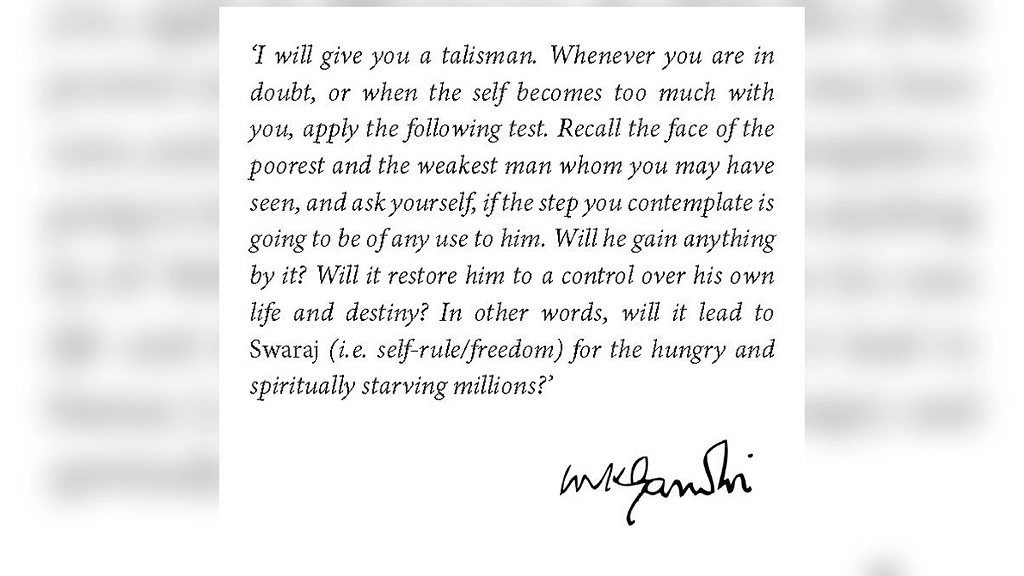
Photo credit: Wikimedia Commons/Seabuckthorn
At a time when references to great works of fiction and mythology have become fraught with ideology, one can draw upon them only with a certain trepidation. However, there is a scene from the film adaptation of ‘The Lord of the Rings: The Fellowship of the Ring’ that I find myself thinking about, now and then. Saruman, the leader of the wizards, who was supposed to lead the fight against Sauron, has succumbed to and openly embraced evil. He is strip-mining Fangorn Forest to fuel his weapons foundries and underground breeding pits, racing to create a massive army for the Dark Lord. Mud oozes as a massive, monstrous Orc-hybrid, Lurtz, rips his way out of a slimy, amniotic sac in the ground. Saruman is shown approaching the towering creature and demanding, “Whom do you serve?” Lurtz looks up, his eyes widening with dark loyalty, and growls, “Sauron!”
Those of us working in the social sector often assume—and are widely assumed—to be driven by a similarly singular, albeit noble, ‘social purpose’. We wear our intent like a badge of honor. But if we are honest with ourselves and drop the layers of personal and institutional masks and vocabulary, is that the only or even the primary thing that drives us? Or do we seek a false comfort in that thought?
Consciously or subconsciously, we are almost always serving someone or something else as well. This is not to say that our mixed motivations are evil, or to demand an impossible, saint-like quality, where one exists entirely above the material world. It is simply an observation of our ecosystem.
As per an estimate made in the mid-2000s, the number of paid employees in the social sector was about 27 lakhs. This is likely to have gone up significantly over the last two decades. For comparison, the largest government employer in India, Ministry of Defence, employs ~30 lakh personnel and the largest private sector employee is TCS employs about (six) 6 lakh employees. It would not be wrong to say that for many, the social sector offers a career path, a source of livelihood—which helps us serve our own primal need for survival—our roti, kapdaa, makaan.
In addition to this, for many of us, it also seems to serve a deep-seated psychological need and appetite for virtue. We possess a deeply ingrained need to see ourselves as good people, to walk what the society (or at least our friends and peers) deem as a righteous path, to signal our virtuosity and collect the subtle social currency that comes with being perceived as a ‘social change agent’.
To reiterate, this is not to claim that such needs make us unworthy or to demand impossibly high standards but to acknowledge some of our deeply human but self-serving drivers.
The distortion deepens, however, when we look outward. We find ourselves subservient to the ‘hands that feed us’: the funders, the CSR committees, the Ultra-High-Net-Worth Individual (UHNI) philanthropists. We sculpt our programs to match their priorities and vocabulary, adopting buzzwords that dominate the current funding decisions. We serve the influential stakeholders, local politicians, and bureaucrats—engineering high-visibility moments, signing ceremonies, and photo-ops—to secure MoUs, permissions, and/or institutional validation. We chase the chimera of scale, obsessing over impact assessments, dashboards and metrics, and policy changes that look beautiful, and are supposed to be the panacea of all social ills, at least on paper.
Perhaps, right at the very end of this long line of masters, if at all, comes the actual human being. The child struggling to follow an alien concept in an alien language sitting on the floor of a bare classroom. The young, anemic mother waiting hours in the heat for a basic health check-up. The farmer staring helplessly at a ruined crop, trying to make sense of the climate’s sudden, violent vagaries. In our eagerness to serve our other masters, we step over the very people we had set out to walk with.
In August 1947, as India’s ‘tryst with destiny’ turned bloody and a new class of leaders and civil servants stepped into the grand colonial offices in Delhi and the various provincial capitals, Mahatma Gandhi spent his days fasting and walking through the communal riot-torn neighborhoods of Calcutta, trying desperately to restore peace. In the midst of that horrific mayhem, when deep despondency had gripped the nation and the monumental task of building a just India felt entirely broken, Gandhi received a letter from a close companion. This friend felt tormented by self-doubt, paralyzed by the sheer scale of the surrounding tragedy, and wondered how an individual could possibly act meaningfully.
In response, Gandhi wrote back with a talisman. While the original letter was mislaid in the chaos, Gandhi seems to have later rewritten the lines from memory, on a loose scrap of paper that was miraculously preserved. One cannot help but feel that while it began as a personal consolation to a grieving friend, it was intended as a moral guideline to the incoming political class, the policymakers, and the civil society. It was a reminder that true independence does not mean a mere change of rulers but something entirely different. He wrote:
“I will give you a talisman. Whenever you are in doubt, or when the self becomes too much with you, apply the following test. Recall the face of the poorest and the weakest man whom you may have seen and ask yourself if the step you contemplate is going to be of any use to him. Will he gain anything by it? Will it restore him to a control over his own life and destiny? In other words, will it lead to swaraj for the hungry and spiritually starving millions? Then you will find your doubts and your self melt away.”
While each of us must navigate the realities of personal and professional needs, funding, organizational survival, and systemic complexity, this talisman remains an indispensable compass for those of us who choose to inhabit this space. Working primarily in education, the question I find myself returning to often, is this: do all our grand efforts—the agreements and MoUs, the workshops, the policy changes, the collaborations—actually alter the life opportunities of the individual child sitting at a desk in a village school or on the floor of an urban community learning center?
If our efforts and interventions do not ultimately restore to that child a sense of personal agency over his/her own life and destiny—a tangible, localized swaraj—then most of what we are doing is perhaps an illusion. We are perhaps servicing our own needs and the machinery of the sector itself.
When the challenges seem overwhelmingly complex, or when the self becomes too much, or the lure of fame, scale, and photo-ops too strong, it might still help to look back at the particular—“the face of the poorest and the weakest [person],” as Gandhi put it, and ask ourselves: Whom do we serve?
And if the answer to Gandhi’s talisman is no, we must have the courage to stop, pivot, and keep striving.



No approved comments yet. Be the first to comment!