
Designing organizations for mutual symbiosis
As organizations increasingly adopt AI and automation, this article argues for a model of mutual symbiosis between humans and machines. Drawing on cybernetics, ecology, and organizational practice, it highlights the importance of human adaptability, collaboration, and shared benefit in building resilient, future-ready institutions.
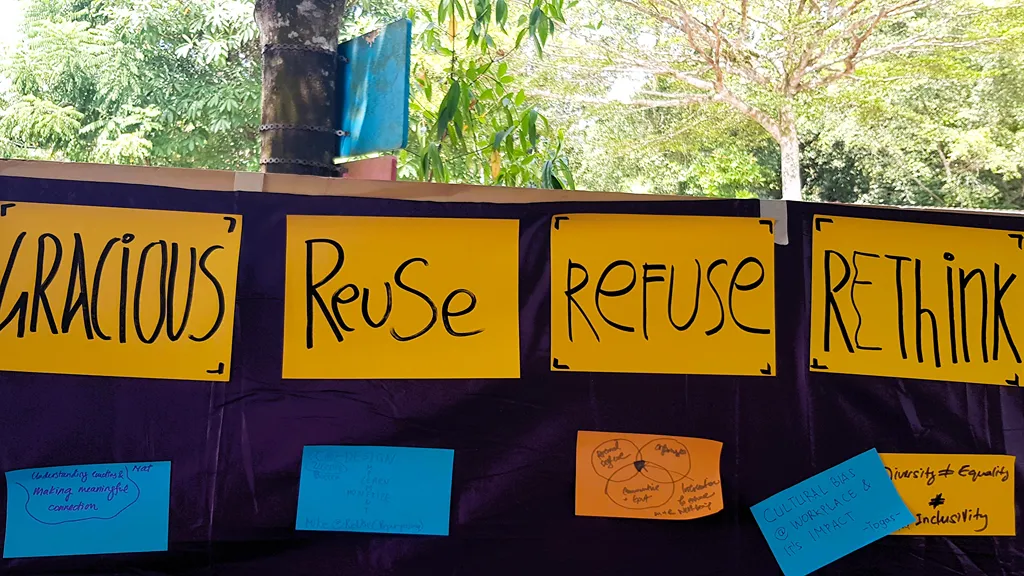
Actions for a more humane world
Photo credit: Francis Laleman
The age of machines
We have been living in an age of machines since the steam whistles of the industrial revolution first disrupted the natural rhythms of life. The anxiety that automated agents will replace human hands is not a novel digital crisis. It is the latest chapter in a long, rolling tension between the rigid efficiency of machinery and the seeming nostalgia of protecting our own human making skills.
Craftiness, in its oldest and best sense, is human knack—the adaptive, contextual, often unquantifiable skill of a master artisan who knows exactly how to respond when the raw material acts up. Historically, whenever we built a new machine, we stripped a part of that craftiness out of the human and hardcoded it into the apparatus to ensure predictable, uniform output. But a fascinating thing happened in parallel. The more complex machines became, the more they seemed to desperately rely on human craftiness to keep them from breaking down.
Cybernetics
This human/machine, organic/inorganic interdependency is the core lesson of cybernetics—a term coined by Gregory Bateson in the 1940s, from the Greek word for ‘steersman,’ which is simply the science of how systems steer, communicate, and self-correct using feedback loops. In a classic cybernetic system, you have a goal, an action, and a constant stream of information coming back to tell you if you are hitting the target.
Early factory owners thought their mechanical looms and assembly lines were perfect, closed loops that could run themselves. Humans remained on board of the system only because they quickly discovered that machines were in fact brittle. They could not handle unexpected noise or the messy complexity of the real world.
When a thread snapped, a gear jammed, or the raw material changed quality, machines would blindly keep running until they destroyed themselves. To survive, the system required a cybernetic steersman. This was a human worker with enough craftiness to sense the error, interpret the feedback, and make a real-time, safe-to-fail adjustment that no rigid blueprint could foresee.
Historically, the relationship between machinery and human craft survived because we realized that true efficiency is not about replacing the human with a machine, but about balancing the loop. The machine provided the raw throughput, but the human provided the adaptive governance.
With the current onslaught of LLMs, GenAI, and agentic AI, we have come to live in an age of machines more than ever. Increasingly, modern organizations are under pressure to redirect investments from humans to machines, lest they ‘miss the boat.’ It is said that ‘agentic AI’ will take people’s jobs. Conversely, it is rumored that people are being laid off, not because AI is flawless at doing their work, but quite the opposite, because it is not.
The messiness of today’s artificial intelligence rollout reveals a very similar cybernetic breakdown as the one that happened in the context of previous automation revolutions. Organizations are trying to cut out the human steersman too early, forgetting that when a complex system encounters unpredictable reality, machines hallucinate and create endless slop. It is human craftiness alone that keeps the machinery from tearing itself apart.
Human crafts are back in vogue
And there is a sociological aspect too. Look how the upcoming GenZ is noted for its love of vintage, analog, crafts, anything handmade. Tired of streaming platforms, our youngsters return to cassette tapes and vinyl records. Videos of traditional vocational skills, from baking artisanal roti in Gali Paranthe Wali to baking hand-moulded bricks in Jharkhand, fill the young generation’s social feeds. Humans and their skills seem to be just as ‘hot’ as AI.
In brief, while we might (again) be brainwashed to doom-think that humans are silently being banned from organizations, and their contributions binned for being ‘without added value,’ an undercurrent appears, wherein new-time organizations, humans, being less in number, are set to count more. And human skills, once sorted out and revaluated, are slated to counterbalance the seemingly all-pervasive onslaught of ‘intelligent’ machines.
One such uniquely human skill is ‘reading the room,’ the hallmark of the effective teacher, the apt facilitator, the true leader, the forward-looking manager, the keen advocacy campaigner, the cautious but forever-driven social activist. When machines and humans find a much-needed new balance, reading-the-room organizational design and similar models must be ready to take up guardianship of an age of cybernetics 2.0, where conversations between and among humans and machines are bound to matter more than ever before.
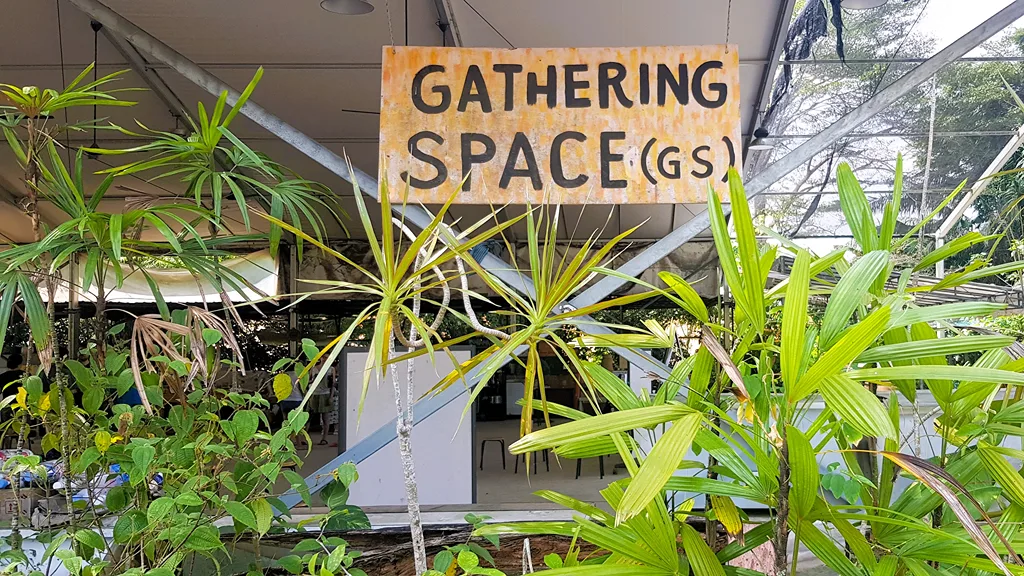
Photo credit: Francis Laleman
Read-the-room organizational design
Mutual Symbiotic Org Design is an example of a reading-the-room framework that I have been experimenting with in a variety of contexts, from the social field with marginalized communities in India, Indonesia, and the Philippines, to global fintech corporates operating from the business districts of Seoul, Shanghai, Hong Kong, and Mumbai.
Mutual Symbiosis (parasparopagraha) is a systems model taken from Ecology. The word ‘symbiosis’ literally means living together. When different species co-exist in a balanced system where every species takes benefit from the symbiotic arrangement with others, and all species contribute to the overall benefit of the system, the moniker ‘mutual’ is applied (in opposition of other forms of symbiosis—commensal, parasitical, and more).
To make matters easier to grasp, in my work, I often refer to Mutual Symbiotic Org Design as an organizational setup where everyone and everything (humans, plants, animals, machines) acts at the same time as a host hosting guests and guest guesting hosts. Mutual symbiosis is the art of multi-directional hospitality.
Future-proof symbiotic design
Organizations that manage to develop design structures and facilitate processes of mutual symbiosis, are both treading in the footsteps of ancient traditions, and building a system that is profoundly future-proof. Biological and ecological histories, including adaptation, evolution, and self-regeneration, have consistently shown that recognition of the profound interconnectedness of all phenomena (paratantra) affords for in-built sustainability of systems.
Likewise, it generates the conditions for the agility required to remain responsive to change. Ancient Indian organizational models have shown the same: think of the intricate symbiotic dynamics and cybernetics designed into the precepts of various shramanic monastic groups and their interrelationship with both forest environments and urban mercantilism.
In the end, it would be foolish to excludes machines from the symbiotic equation. Machines and their software (some would say ‘intelligences’) are man-made figments of our human imagination and capacity for making. Therefore, there is no fundamental difference between goats herded by goatherds, pots moulded by potters, paintings painted by a painter, writings written by a writer, software encoded by software developers, data processing systems developed by engineers, and AI systems launched by a collation of human intelligence.
If there is symbiosis, it is, almost by definition, a symbiosis of everything. Therefore, an organizational design model taking mutual symbiosis as its core principle, may be the only organizational design model we have left, that has futureproofness encoded in its very DNA.
Hosting guests and guesting hosts
Over the past two decades, I have collected experimental rollouts of Mutual Symbiotic Design practices in a wide specter of organizations and communities across continents.
It will not come as a surprise that this comes with a great variety of outcomes, dependent on levels of receptivity, readiness, and freedom of oppression in the nature of systems concerned.
Of course there are other factors, but here I limit myself to the above three:
Receptivity (kṣānti) refers to the degree in which an organization is open to respond to change and transform itself accordingly. Some organizations I have worked with are like organisms. They cannot but be receptive to being responsive to change. In a way, they are symbiotic already. They have been so ever since they started. With them, I apply design features affording for transparency, clarity, and continued symbiotic awareness.
Other organizations are like lifeless objects. They are who and what they are, and forever so. They are oblivious to the fact that they, like many of the artifacts that humans have been producing through the ages, have no protection against becoming redundant. For some, redundancy is an acceptable outcome, provided their goals are achieved. For others, imminent redundancy causes a stir of panic and the urgent need of a lifeline.
Readiness (yogyatā) refers to the organization’s in-built features for self-reflection, collective knowledge and skills development, and levers for adaptation. If those are in place, shifting the focus from a binary, man-versus-machine dynamics, to one engrained by mutual symbiosis, does not come at great cost or effort.
Freedom of oppression (sabhāgata) is a design feature I take from Paolo Freire’s ‘pedagogy of the oppressed’—where systems are diagnosed to have been thriving on a basic principle of singular non-mutualism. Everything in these systems is strife, competition, finite games, winners-versus-losers. Successes of one, always seem to come at the expense of another. Humans and machines do not collaborate, they compete. Hosting and guesting are all but absent. Rather, what we see is hierarchy and serfdom.
My work experience has taught me that it is key to align these systems to the insight that they too are symbiotic, only their model of symbiosis is parasitical rather than mutual. This done, and the principle of symbiosis established, shifting from one symbiotic behavioral pattern to another becomes a feasible outlook.
The future will be human or not
It would be a great mistake to forget that people need people and let machines take over every aspect of our common future. In the meantime, we need to prepare for both symbiotic improvement and improved symbiosis, ensuring that the core principle of mutual benefit remains at the helm of our common civilization. A future for human collaboration either will be human, or it will not be.
Related Articles
By | February 6, 2026
No approved comments yet. Be the first to comment!