
Responsibility and anxiety: the meeting about the assessment
This reflective piece explores responsibility, teamwork, and anxiety in educational assessment. It highlights how ownership, collaborative processes, and self-awareness shape fair evaluation practices and personal learning within institutional settings in the context of civil society interventions in education.
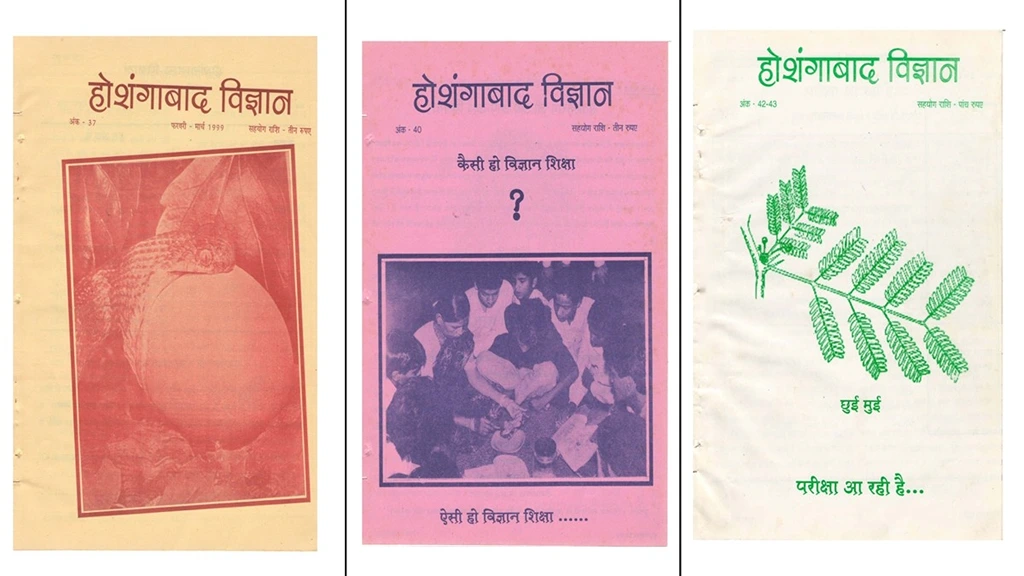
My serious engagement with Hoshangabad Science Teaching Program (HSTP) began early. From the first visit itself, I felt I had a role. And this role began to extend and expand with each short visit. The assessment of students was to be done, and the training of the teachers came up.
And then, back in Delhi, there were meetings about the program and what to do with it. All these long meetings did not make much sense to me at that time. There was too much of, what I then thought, needless conversation. But nevertheless, it was interesting. Maybe this also gave me a sense of pride to be a part of this group that seemed so intense and capable, and I stayed.
Apart from all that, there was also the interesting and new work of participating in the development of the materials for the classroom transactions, namely, the ‘Bal Vaigyanik.’ The HSTP Program involved the creation of collated material in the form of a book for the schools where the program was to run.
A lot of interesting work was taking place. This was of course apart from the meetings, where people apparently sleeping eventually ended up summarizing the conversation and spelling out the path forward. This was quite startling for me. I am sure others also would have had that experience too.
But over time we look at such processes with a fresh insight. ‘Meetings’ do not seem like an apt description for such open-ended processes and conversations. These processes were an ownership building exercise. These also helped build ways of appreciating the different dimensions and aspects of the work.
All this helped understand the rationale for the decisions being made and the details as to how it would move forward. This was perhaps something obvious to those who were already deeply involved in the task. However, the process itself was essential to get the others to feel ownership and commitment and to understand the ground situation and its nuances.
My relationship with the work was growing. I was very proud when I was given the responsibility of the final Board assessment of students of class VIII from the HSTP schools. I was even made a comptroller of examinations. This task required and expected me to work with other people from a very different background and ensure that we were able to function as a team and maintain rigorous quality and consistency. We had the task of producing an ‘unbiased and error free’ completed marks list.
The task was complex as the assessment was for a paper that was an open book exam. The questions, therefore, were of a kind that required the student to make a response based on the given situation. There could be a variety of answers possible. We had to judge each answer on the merit of how it related to the possible reading of the question by the student. Many answers could be correct and many partially correct. Even after these questions had been read carefully, multiple interpretations did sometimes become possible.
The procedure adopted to ensure correctness and fairness, and to make the assessment meaningful, was to redistribute or renormalize the marks allocated to each question. More on that can be read elsewhere. But the process, in brief, was to change the marks that were pre-allocated to the questions based on the assessment of its level of complexity and the effort involved.
At the time of this event, papers from only 16 schools (in all about 500-600) were to be evaluated. From these, a small 10% set of randomly selected papers was taken using the random number tables. At first, these papers were evaluated to develop the evaluation blueprint.
A small group looked at the papers, marked them and developed the marking scheme for the question. Once the marking was done with the same set of people looking at the same set of questions, the question-wise marks tabulation was done. Based on this, the facility and discriminatory indices were calculated for each question using the top and bottom one-third in the merit list of the sample. These numbers became the basis to redistribute the marks.
The redistribution was dependent on the marks received by the students in a question. Any error in the marking or tabulation was to be avoided. No one was supposed to put a mark of any kind on the answer script or leave any trace of the paper having been checked and marked. The actual marks for the exam would be given by the evaluators later when these papers were redistributed for evaluation.
Apart from not putting any mark on the paper, one of the other important aspects of avoiding error was uniformity in marking. And so, here I was diligently looking at all the sample papers, giving suggestions, and primarily satisfying myself that things were in order. Then, I found an error and what followed was another lesson for me.
Before I go there, a bit about the people in the process. This program was being implemented with the Department of Education. Therefore, most of the people working alongside me were government schoolteachers who had taught the subject to class VIII students.
Apart from them, there was also an ADIS (Assistant District Inspector of Schools) who was the representative of the district head. The ADIS was a position of authority and power for the schools and the teachers. They could, just by their looks, silence most of the teachers. They could be a terror for the schools and the teachers in them. The ADIS were used to being treated with respect and having their way.
This particular person was a bit different in interactions with the program. As a part of the people present, he was keen to participate and do things. He was not content to just sit like an administrator, find faults and throw his weight around. I was told that the teachers in his region were terrified of him. He was always able to get them to make their best effort. He had opted to be a part of the HSTP as he felt excited about something new happening.
He happened to be the part of the team that had been judging the question. There were not only marks that had been made on the papers but some oversights as well. I was upset and angry. I started a meaningless shouting exercise. I shudder to imagine the scene—a 23/24 years old upstart screaming at someone over 55 who could just ask me to shut up and walk away with all the teachers.
But he just listened to my harangue patiently and then quietly asked the question, “Aap daant rahe hain yaa samjhaa rahe hain?” (Are you scolding me or explaining things?). Effectively saying that I was in fact not helping him understand.
It was as if a bucket of water was thrown on me. I felt extremely embarrassed. We sorted out the issue without much trouble. But the line has stayed with me. It keeps coming back to me whenever I repeat similar behavior. I also have been able to identify a pattern of anxiety associated with such outbursts. This seems to be rooted in a feeling that ‘I am responsible’ and not ‘We are responsible as a team.’
It seems like all our lives we have to keep learning the same lesson repeatedly and be lucky enough to find a Khare saheb (as he was called) or be strong enough to be a Khare saheb. It also tells me constantly of the countless people who have managed to teach me in practice what it means to act meaningfully in the way we all pontificate about. These small incidents show that practicing what you preach to the world is not always natural or easy.
Related Articles

By | April 1, 2025
No approved comments yet. Be the first to comment!