
Scaling up of educational programs of CSOs: is it a given?
The article critically examines the push to scale CSO-led education programs. It highlights tensions between quantity and quality, and urges careful choice of scaling pathways to ensure contextual relevance, depth, and sustainability.
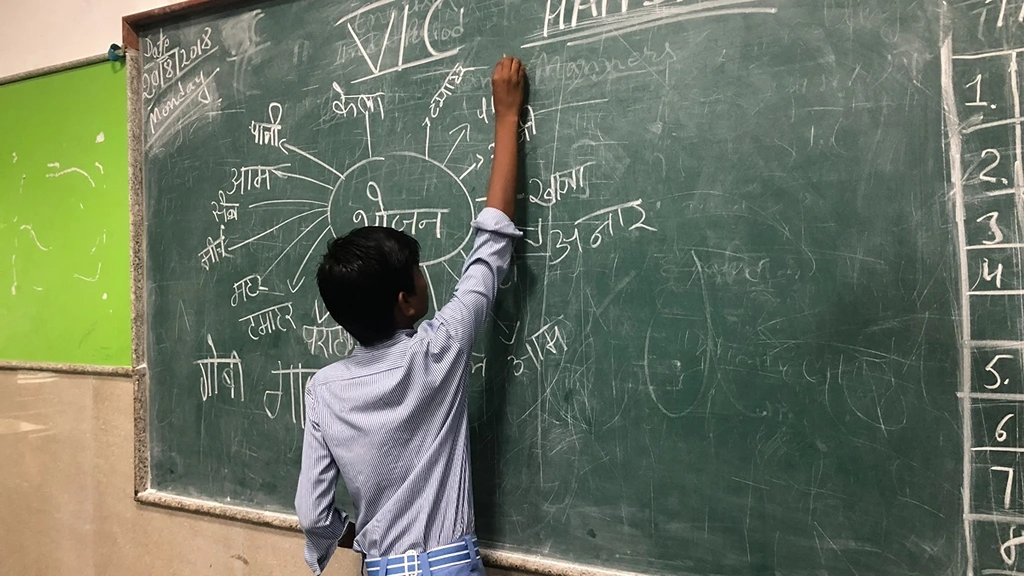
Student from a government school run by the Government of Delhi defining "happiness" in Happiness Class, part of the Happiness Curriculum
Photo credit: Wikimedia Commons/Government of NCT Delhi
Introduction
The idea of scaling up educational interventions, like other development interventions, is not new. However, the emphasis on scaling up has increased considerably since centrally sponsored schemes (e.g., DPEP, SSA, CSSTE, RMSA, SMSA) became one of the main approaches for increasing education access from the 1990s onward. Besides the government, at present non-state actors, both CSOs (Civil Society Organizations) and donors and funders, have become aligned to an idea that all interventions need to be scaled up.
This brings us to some important questions: what drives such a move toward scaling up almost across the ecosystem? Are all interventions worthy of being scaled up? What determines ‘worthiness’ of interventions for scaling up? What trade-offs are made in choices between scaling up and not scaling up of a worthy intervention?
Quantity vs. quality
The move toward scaling up can be seen, at one level, in terms of the role of non-State actors having increased significantly in different areas of education in the last two decades. These areas span curricular materials, teacher training, assessment systems, school management, education innovations, and so on.
Alongside, donors involved in funding interventions in education have aligned their outlook to the idea of social impact investing. In such an outlook, short-term, easily measurable indicators of educational change, in large numbers (the units could be children, schools, administrative units, or geographical sites), have become the default rationale for allocation of funds. The competitive ecosystem of funding has increasingly driven CSOs to orient themselves, willingly or unwillingly, with this outlook.
Besides the non-State ecosystem, bureaucrats also prefer operations at scale. They often encourage CSOs to implement their initiatives across larger administrative units, be it the block, district, or state, or even across multiple states. This logic derives from how bureaucrats view ‘welfare’ or ‘developmental’ interventions by CSOs as similar to how government schemes need to cater to the needs of entire target population groups, rather than select geographies.
In this scenario, an expansion of ‘quantity’ continues to foreground how CSOs, donors, and the State understand ‘scaling up’ of education innovations. This leads to a devaluing of nature and quality of educational initiatives and the desirability and/or possibility of all interventions being scaled up. The assessment of initiatives for scaling up would require one to move from the parameter of only ‘quantity’ to including parameters such as depth of implementation, shifts in norms and beliefs (of adopters), and sustainability for widespread use.
Processes
If we start examining ‘scale’ more closely, we see that there is a usage of the term in the ecosystem that treats it both as a process and an outcome. While more attention is paid to the second usage of the term, where we refer to a larger number of end users being catered to through an education intervention, the attention to the former is lower.
Generally, four processes of scaling up have been proposed from different development interventions. These are adoption, replication, adaptation, and reinvention, with each requiring a different strategy. When we apply these models to probable real-world scenarios, we can understand them better.
Adoption, for example, happens when there is a widespread use of a hitherto limited application of an education innovation, without a clear conception of what use the innovation would be for larger number of users. This often is seen to be the case with curriculum/subject kits that are supposed to supplement or complement traditional teaching-learning in schools and may find intensive benefits in a limited-user implementation but then are adopted for use by entire districts/states without attention to how these kits need to be used at scale.
Replication is another form of scaling up where activities related to an intervention are reproduced in new locations or with new users. This, for example, may be observed when CSOs attempt to introduce their ‘successful’ initiatives in specific sites to newer geographies, often using same activities and approaches. In the current scenario, justification for such replication is often drawn from Impact Evaluation results through Randomized Controlled Trials (RCTs) in the primary location.
Adaptation for scaling up is similar to Replication, except that contextual changes needed for the intervention to produce expected outcomes in new sites are incorporated in the program design. As compared to adoption, replication, and adaptation, reinvention is a relatively new idea in scaling up, emerging from the increasing use of digital resources in education. Local adaptation of innovative interventions is the key feature of this model, where this adaptation is often understood as being undertaken by end users.
Strategies
In addition to the different pathways, these models of scaling up illustrate, it is easy to note that adoption and replication would align more with top-down strategies for initial legitimacy while adaptation and reinvention would fit better with bottom-up approaches. Top-down strategies would be evident to CSOs who have chosen adoption or replication as pathways for scaling up and have needed to seek endorsement in the form of MoUs (Memorandum of Understanding) or letters of approval from senior levels of the education administration system for early buy-in at the lower levels.
On the other hand, there are also those CSO programs, which involve working directly with street-level functionaries, such as teachers, headteachers, CRPs, BRPs, and PEEOs (Panchayat Elementary Education Officers). Scaling up of such work would involve the uptake of these programs through validation mechanisms that are bottom-up. Bottom-up approaches are seen to work through mechanisms like word-of-mouth approvals, communication through both formal and informal networks at lower-levels, and engagement-application-reflection methods used by the target groups.
Inherent in the understanding of the four models is the idea that these models need not operate as mutually exclusive ones. For example, in a particular pathway of scaling up, a CSO may start with adoption as an idea of scale to help build initial legitimacy through top-down endorsement for the intervention, especially in contexts where there might be pushbacks or norms that do not align with the ideas behind the intervention, and then shift to replication or adaptation to meet more specific context-based bottom-up objectives for use and outcomes.
Conclusion
Thus, we see that CSOs need to engage with several questions when thinking about scaling up their education interventions. At one level, the main dilemma can be posed as the ‘worthiness’ of a proof of concept being scaled up. This often requires attention to not only resource availability, but also the theory of change for scaling up which would need to be rethought given that trade-offs are involved in terms of breadth and depth of outcomes that CSOs are seeking to achieve through scaling up.
At another level, the pathway to be chosen for scaling up and the different implications they have for working with the education administration system (top-down vs. bottom-up) is another important decision that needs to be thought through. In the current ecosystem, it seems the wider preference is for adoption and replication with top-down approaches. This raises concerns about ideas of autonomy, decentralization, contextual embedding of educational efforts that have often been found to be inadequately addressed in large-scale programs.

Related Articles
By | October 30, 2025
No approved comments yet. Be the first to comment!