
The tenacity of the human spirit is like wildfire
This essay is a reflective account of facilitating organizational change at ASTHA, a CSO working with the disabled. It highlights slow, co-created transformation, the power of listening, and embracing uncertainty to nurture trust, leadership growth, and collective action.
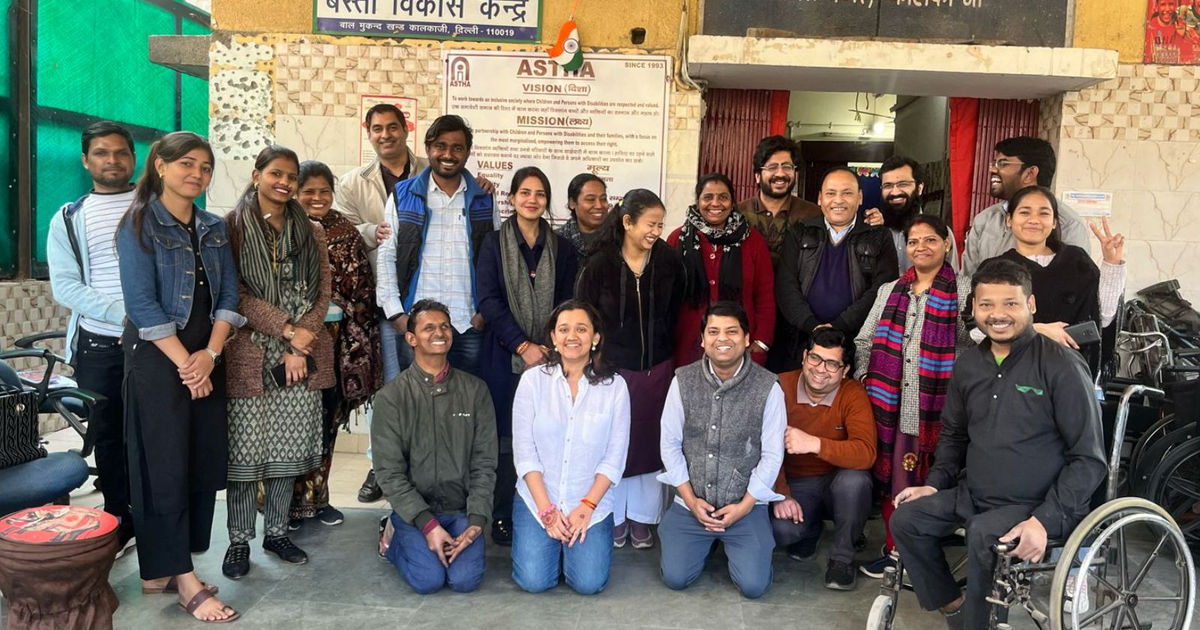
The ASTHA team
Photo credit - Anu Mishra
After a decade in grassroots social work, I was beginning to feel anxious, rushed, and creatively isolated. I craved a safe community of organizational designers and facilitators to process the tensions and failures of our field. I entered the Organization Development and Design (OD&D) Fellowship program serendipitously and this journey became my search for belonging. I wanted to escape the scripted leadership tracks designed for small-town graduates like me.
Rather than an abstract concept, ‘Change management’ felt deeply personal. I wanted the opportunity to explore this more intimately. As an external fellow in the OD&D program, I was to partner Pratik, the Executive Director of ASTHA, in their change journey. And Pratik was going to be my window to this mysterious new portal of understanding change.
Pratik’s worldview
Pratik wasn’t the loudest voice in the room, but the weight of his words often lingered long after he had spoken. There was no rush in his framing of things. What he offered instead was presence—a way of being that invited reflection without demanding it. He carried a clarity that came not from needing to be right, but from having spent time listening deeply to the systems he was part of.
What struck me most was his way of describing his approach during our overstretched coffee breaks: “Anu, my desired direction for ASTHA is not just what I think. It must be co-created together because that’s how I have learnt anything here.” That stayed with me. I was consulting with a leader who was not only looking for strategic answers but could also tune into what was already present, helping people notice their own patterns, contradictions, and possibilities.
There was something positively intentional about the way he worked with teams. As someone who had associated change with urgency, energy, and disruption, sitting with Pratik’s framing made me realize how unfamiliar I was with the idea of slow change in organizational design context. It reminded me to remember the lessons from community transformation experiments where change can emerge not just from intensity, but from attention—gently rearranged.
The OD&D dance begins!
Our beginning wasn’t marked by clarity at all. I arrived in the space holding the disrupting energy of hustle—building new structures that energize: a facilitation style guided by intuition and quick action. Pratik, on the other hand, brought grounded stillness and nuanced emotions of caregiving work. We both wanted to learn from each other and bring complementary energies to this project. There was also deep mutual respect and appreciation for the work done by each of us, and that made me feel welcome.
We met at a crossroads in ASTHA’s 33-year evolution. To me, ASTHA felt like a large joint family; deeply rooted in collective memories of victories and grief shared with its communities. Bonds extended beyond work hours, fostering an intimacy where older generations mentored with presence, patience, and quiet power. Yet, a shift was underway. Following a string of recent resignations, Pratik gently voiced his concern. It was clear that something older was unravelling, more than just attrition. Looking for resonance rather than a quick solution, he quietly signaled a leader’s difficult plea for support. This marked our first step together: him learning to speak his truth, and me learning to truly hear it.
Embracing shoshin: the beginner’s mind
Shoshin is the Zen principle of ‘beginner’s mind’ that offers a powerful lens for anyone navigating change. It invites us to set aside the weight of expertise, past experiences, and fixed assumptions, and instead approach challenges with openness, curiosity, and humility. When we aim to cultivate shoshin, we create space for innovation and deeper listening, enabling teams to see possibilities rather than constraints.
The experiment of ‘Ek ASTHA anek kahaniya’ (One ASTHA many stories): As we started engaging smaller groups within the organization, using a variety of facilitation tools, we began untangling a simmering spaghetti bowl of narratives. We uncovered silent, critical threads: salary tensions, demands for operational excellence, the deep fatigue of community-based work, and uncertain leadership trajectories within the system.
The tools helped create a sense of newness and inclusion in conversations that were perceived as ‘only leadership conversations.’ These had also started signaling how the next desired change needs co-creation. These tools didn’t give us answers; they gave us access to the energies (individual and collective) that have been making adaptation to change possible before. We wanted to tap that and maybe amplify that as well.
‘Ek ASTHA anek kahaniya’ was born with this realization.
What began as a monthly space for teams to creatively connect—not for project briefings, but to make sense of Pratik’s fellowship learnings—became a catalyst for change. By creating a container to speak freely, teams experienced a necessary ‘steaming off.’ These intentional, informal spaces provided conscious breaks from routine and unlocked internal energy. New donors had accelerated the scale of work, forcing rapid restructuring. This left teams busy but misaligned, heightening Pratik’s urgency to solve deeply entrenched issues, such as adapting specialized documentation processes for larger scale.
Over months, the Ek ASTHA anek kahaniya experiment taught us to listen for what was not being said, track invisible energies, and resist the urge to ’fix’ things too early. This liberated my role, shifting from ‘facilitator as center’ to ‘facilitator as witness.’ We committed to our routines religiously. Every Wednesday at 8:30 a.m., we held process check-ins and maintained a shared digital journal. I added photos of cafes, trees, and skies to anchor our abstract universe. Utilizing appreciative inquiry tools, we met teams independently to gather insights without overanalyzing, honoring our physical limits with breaks. We invited peers to observe our communication loops and offer feedback. Throughout, Pratik’s humor—shared via gardening and bird-watching photos—grounded us.
In this first phase of design thinking, we were learning to truly empathize before rushing to define the problem.
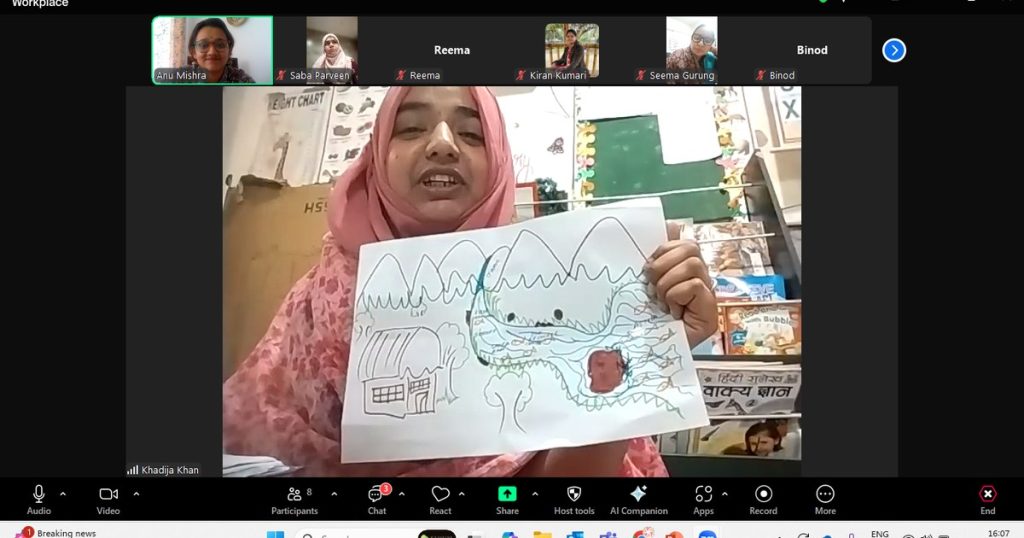
Photo credit – ASTHA
Par problem kya hai? (But what is the problem?)
The history and legacy of ASTHA’s world felt like both a burden and a kind of glue. “No one can truly understand our work without spending time in the community,” Pratik often noted as we struggled to pinpoint a single problem. Our early attempts to ‘define’ a design problem felt too jargon-heavy, framing the issue as a lack of a co-designed organizational development framework. We soon realized this was a symptom, masking deeper questions: What does scaling look like for a relationship-rooted organization? How do we balance well-being with shifting funder expectations? How do we navigate compensation differences between legacy grassroots staff and newer members?
A breakthrough occurred during a fellowship peer-sharing meeting with a contemporary nonprofit. As the facilitator, I felt a rising tension, worrying about psychological safety and competitive undercurrents. After the call, I felt heavy and defensive, realizing how much I romanticized cultural narratives—feeling as though I was exposing ‘family fights’ to neighbors. I reflected on how legacy organizations, much like traditional families, often only legitimize obedient or celebratory voices.
Conversely, Pratik emerged from the same call energized. “Something just released within me,” he smiled. “What is holding me back? We just must do it now.”
This shift sparked an unexpected outcome—a desire to write. ASTHA’s leadership cohort united to document their challenges and co-create an evolving strategy document spanning program priorities, people development, and organizational clarity. This collective writing process generated genuine momentum and hope. The group began generating their own complex questions, completely moving beyond the fellowship’s prompts. In that moment, my role as the central driver shifted. The power displaced from the facilitator returned to the organization, marking the beginning of something much deeper than our initial engagement had set out to achieve.
Making space for leaders to reflect and act
The energy has shifted.
In the beginning I wanted to see a clear problem statement, reflection from tools, all moving in a neat, linear path to lead change. Instead, I found myself holding space for the leader to be chaotic and human. To feel reassured, to feel confident. To find energy and momentum that was true to his pace and needs.
I am now beginning to understand what coaching might look like. Being an honest soundboard makes transition possible. A space that is both safe and brave—where people can show up in their reality and do the work with care.
It is also a journey of trust. Of believing in the possibilities that open when human relationships are honored not for efficiency, but for depth.
Through the fellowship’s regular meetings, reflection prompts and peer stories, I realized organizational change isn’t always a grand event; it seeps in through tiny, heavy, meaningful conversations. The program invited me to view facilitation as an inner journey rather than a workshop performance. I learned to embrace stillness, using my inner landscape to build intentional presence and trust. This year-long (and continuing) work with ASTHA reminded me why I chose to work in this sector: the people. Their motivation to stay with the struggle, their belief in collective progress, and their ability to find joy in the smallest, simplest places.
A note on ASTHA: Established in 1993 to drive community-led change for children with disabilities, ASTHA has shaped national and global movements. It began in Delhi’s slums, intentionally prioritizing community-based rehabilitation over institutional care. As India’s rights movement matured, ASTHA expanded into national advocacy, launching a National Disability Helpline in 2005. By training mothers and elevating disabled leaders, it championed self-advocacy. Later, ASTHA integrated disability rights with urban welfare, anganwadis, and schooling. During the COVID-19 pandemic, its embedded presence fueled rapid remote support and systemic advocacy, reinforcing its role as a powerful national voice.

Related Articles
By | April 29, 2026
No approved comments yet. Be the first to comment!