
Productive work, language, and knowledge
This article recounts a six-year Nai Talim experiment in rural Madhya Pradesh, where children learned through productive work such as farming and carpentry. It shows how real-life problem-solving fosters deep, integrated learning and confidence, while also highlighting risks—like social disconnect and arrogance—when transformative education occurs outside the mainstream schooling system.
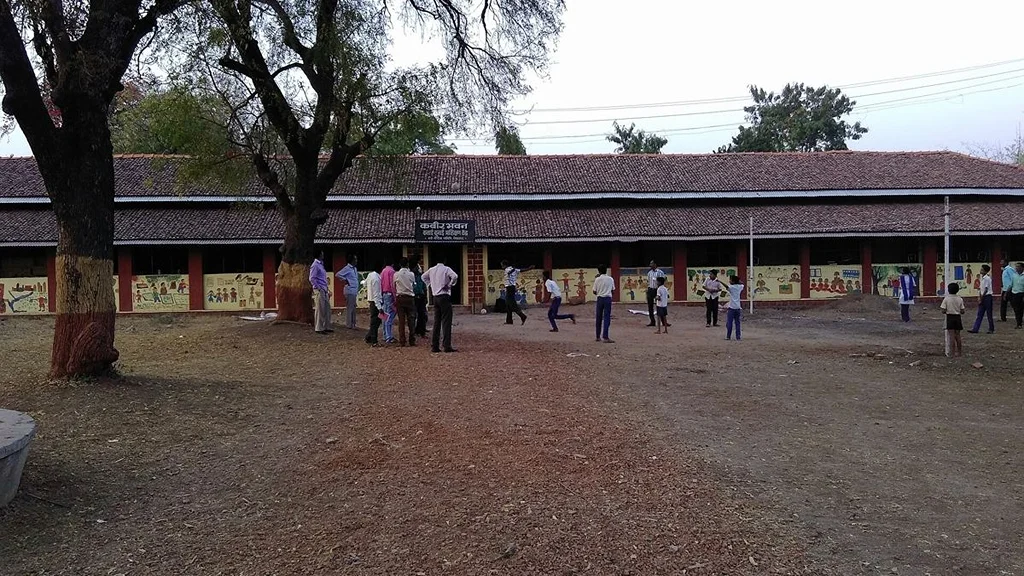
Kabir Bhavan, Nai Talim Samiti, Sevagram, Wardha
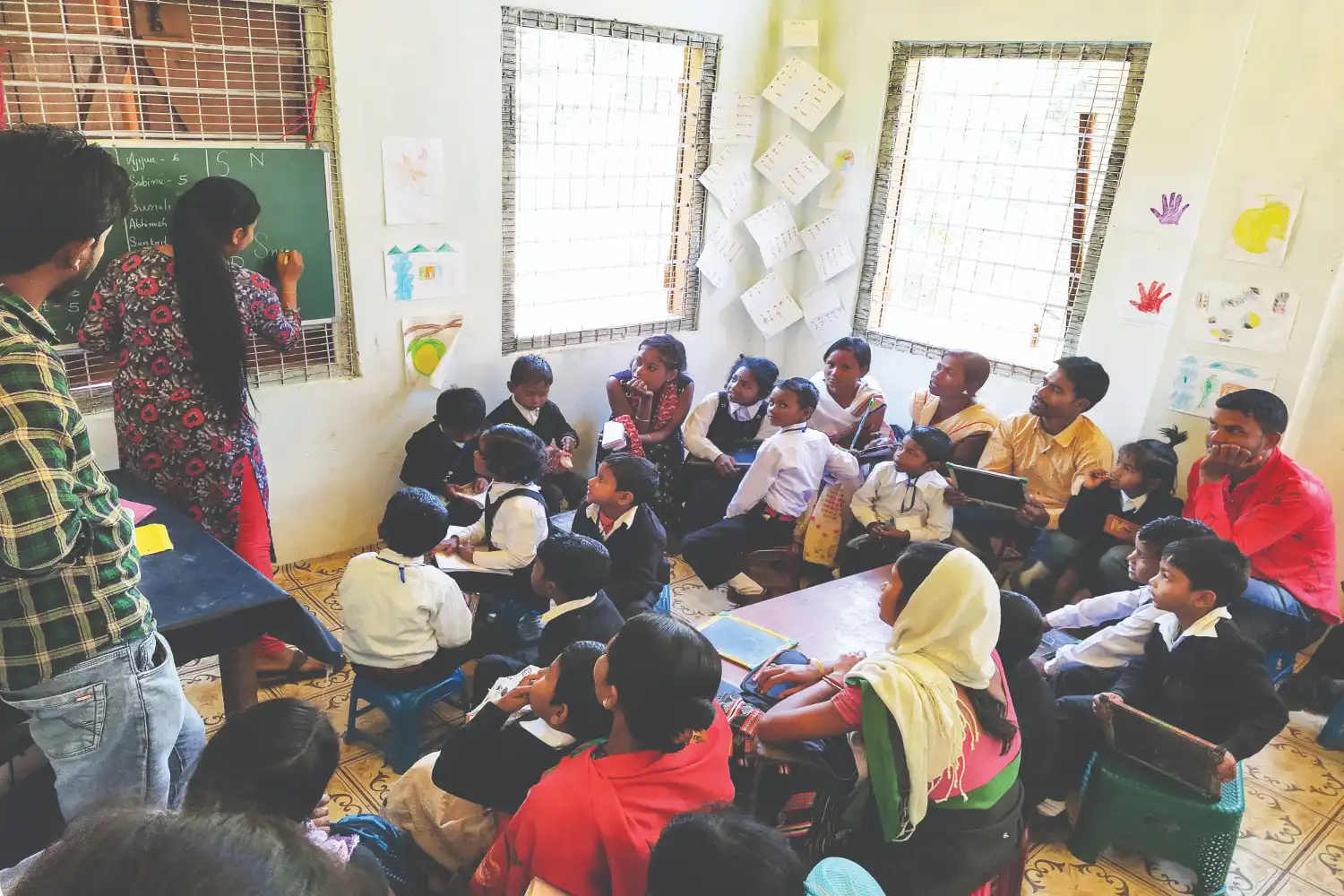
Photo credit: Wikimedia Commons/Kailash Mohankar
The pedagogy of productive work, language, and knowledge that I am about to speak about has a background of lived experiences. It is based on the work we did in a village in Hoshangabad district. In that village, roughly half of the population consisted of Adivasis and Dalits; about 15% were Muslims, and the remaining population belonged to other castes. In that village, we conducted experiments related to Nai Talim for about six years. This is the story of those experiments, and the experiences that emerged from them, that I wish to share with you.
Around twelve children from neighboring villages came together for this experiment. However, the atmosphere of that time was not such that girls could be part of such a program. I am speaking about the years between 1972 and 1977. Therefore, all of them were boys. They came from families where their parents were agricultural laborers or very poor farmers. These children had studied in government schools up to Class 4, 5 or 6, and beyond that they had dropped out of formal schooling.
The work that we took up was that we had some agricultural land, and the teachers and the children together would cultivate that land as a group. There was also a cow there, so the children, along with the teachers, reared the cow. They learned how to take care of it. Along with that, they also learned carpentry work. They learned how to repair irrigation pumps. The underlying principle of learning was that whatever work is to be done will be done by us, and it will be done collectively. Whatever is produced from that work will be taken to the market, sold, and its accounts will be maintained. Apart from this, there was no textbook. This was a program without textbooks.
When the work began, we told the children: here there is about six to seven acres of land; from this, you should measure out one acre. We will do cultivation only on that one acre. And since it is the season for groundnuts, we will grow groundnuts there. As soon as this was said, a discussion began among the children: what exactly is one acre? How big is it? They began trying to find out how many square yards make up one acre. That itself became the beginning of their learning process.
Then the question arose among them: what exactly is a square yard? What does it mean? And from that point, the study of geometry began. When they developed some understanding on paper, the next challenge was that now the land has to be measured in reality. How should it be measured? For one or two days, conversations and discussions continued. Finally, the children decided that they would measure the land using meters. They also made a kind of instrument, similar to a compass, which is locally called a ‘parkal.’ Using these, they went and measured the land. In the end, they measured it in the shape of a rectangle.
Now, whatever work was being done had to be recorded in a diary. But their mother tongue was not Hindi; it was Bundelkhandi. So, a question arose: in which language should they write? After thinking about it, the children themselves decided that they would write in Bundelkhandi—because that is the language they know. One writes best in the language one already knows. So, their diaries began to be written in Bundelkhandi language, but in the Devanagari script.
We decided that all of us would sit together and read those diaries collectively. After reading them, discussions would take place—what we have learned, what remains to be learned. However, one important decision was that we would not point out mistakes of language in those diaries. Because if we started pointing out mistakes of grammar, spelling, or word order, then the natural enthusiasm for writing that had emerged among the children would get suppressed. Therefore, grammar, matras, spelling, sequence of words—all of these were kept aside. We focused only on whether what the child had written conveys the meaning or not. The emphasis remained on learning: when you measured the land, what did you understand from that? The role of the teacher was to pose questions from time to time that would take their thinking further, that would make them reflect more deeply.
Then, the work moved ahead. Groundnuts had to be sown. The children asked: how is groundnut sown? We told them honestly that we do not know. So, the children went to the farmers in the village and asked them: how much groundnut seed is required for one acre of land? Being village children, they already knew many aspects of preparing the soil. Whatever they did not know, they asked and found out. They prepared the field properly, ploughed it, and sowed the groundnut.
Next came the stage of applying fertilizer. They found out that urea is applied. We asked them: why is urea used? What does it contain? What benefit does it bring? They did not know. So, they went and asked the farmers. But the farmers also did not know the answers. Since the answers could not be found, they decided that they would go to the Block Agricultural Extension Officer—the AEO.
When they reached there, the peon stopped them and asked, “Who are you?” They replied that they were students. The peon said, “if you are students, then you should go to school; what work do you have here?” The children insisted that they would meet the AEO and then go. But the peon did not allow them to enter. They returned, some of them even crying.
After this, the children decided that they would go again, and this time, they would not ask the peon for permission. They would go straight inside. The next day, around ten children went directly inside the office and stood before the AEO. They said, “Sir, please answer our questions. We have come here to ask something.” The officer asked them, “Do you only want to apply urea, or do you want to understand what it contains and what it does?” The children said clearly, “We will use it only when we understand it.”
The officer said that he did not have time and handed them a printed government booklet. They brought that booklet back and read it. It mentioned that urea contains nitrogen. Then we said, “Open a Class 10 chemistry book.” And thus began the lessons in chemistry.
What is the principle of this kind of pedagogy? The principle is that whenever, in the course of productive work, children reach a stage where a natural question arises—something that is directly linked to the work they are doing—then at that very point they will study that question. They will read books. They will try to understand. So questions like what is nitrogen, what is sulphur, what is potassium—all these were discussed. Even the classification of elements, the periodic table—these also came into the discussions. But only to the extent required at that moment. At that stage, it was simply an initial acquaintance with chemistry.
As the groundnut plants grew, something interesting was observed. Near the plant’s base, a flower-like formation appeared. Its branch bent and went back into the soil. Village children were familiar with this. But one child asked, “What exactly is this? What is happening here?” We said, “We do not know; you find out.” They looked into books of botany—Class 10, Class 11, Class 12. They did not find the answer. Then we suggested, “Go to a bigger library.” Two or three children went to the city and searched in a large library. Even there, they could not find the answer.
Then we said, “You have tried a lot. Now let us sit and think together—what is a flower?” And thus began a discussion, and the lessons in botany started unfolding.
Meanwhile, through continuous study and work, the groundnut crop became ready. It was harvested and dried. Now came the time to sell it. At this point a very difficult question arose. When we sell this crop, will we recover the money we have spent? We have kept accounts of every expense—will that amount come back or not? The children decided that they would sell only if they received a good price.
But how would they know what is a good price? They went to the market and asked about the price. At that time, if they sold, they would face a loss. So, they decided to wait. When the price goes up, then they will sell. They decided that every Friday, when the weekly market was held, they would go and find out the price.
Then we asked them, “How will you know whether the price will increase further or decrease?” They did not know. Then they were introduced to the idea of a graph. What is a graph? How do we make X-axis and Y-axis? How can each week’s price be plotted as points on a graph? They learned all this. They observed that when the line showing the increase in price starts flattening, the slope becomes smaller, then the increase will not continue much further. That is the time to sell, otherwise there may be a loss.
They themselves took these decisions on the basis of the graph. Work that even students of Classes 11 and 12 often cannot do, though it is in their syllabus, these children learned along with their work in the field. They even learned how to measure the slope of the graph.
Alongside geometry, algebra, and chemistry, now social science also entered. One day, in a collective meeting, a child asked, “Why does the price rise so much and then come down? Once a price is fixed, why does it not remain the same?” This question led to a discussion. Suppose a large quantity of groundnut suddenly comes into the market—will the price rise or fall? What is the relationship between supply and demand? Through such discussions, the principle of demand and supply was understood.
Then the children asked. “Where does so much groundnut come from? Let us find out in which parts of India groundnut is grown.” They opened geography books, opened maps, and found out that a large quantity of groundnut is grown in Gujarat. Then they said—this is Gujarat. How far is it from our village? They did not know.
So, let us measure the distance. First, measure it as a straight line. Then, measure the route by railway. But on the map, it is just an inch—how will we know the real distance? Then, they noticed: there is a scale on the map. They had not paid attention to it before. Many senior students even do not know how to use that scale.
They examined the scale and began to understand it. If this small length corresponds to so many kilometers, then we can calculate the actual distance. They used the scale, drew lines, used a thread, and measured distances. They calculated how far Baroda, a city in Gujarat, is from their village. Then, they began to think—how many days will it take to walk there? How much time will it take by train? They found out that they would have to go via Itarsi. They learned how to read railway timetables.
Now, the explorations into geography started expanding further. Which rivers lie along the route? Are there bridges? How can we know? Sometimes maps show bridges, sometimes they do not. But if trains run, there must be bridges. So, they searched for railway maps. They traced routes, bridges, and paths.
Thus, the study of geography advanced very well. Along with it, the study of economics progressed, mathematics continued, and chemistry also developed.
The most important change that took place was in their confidence. They felt proud that now they could go to the office of the AEO without asking for permission. No one could stop them. They also felt that the AEO did not know much. When they asked questions, he would tell them every time to read from a booklet. Slowly, they felt that they themselves knew more than the AEO. They thought they could go to the officer and ask him, “Sir, could you please tell us what is nitrogen? We know it now!”
Now, they had courage. A kind of political confidence began to develop. They felt that they could talk to anyone now. Fear disappeared. For poor children, losing fear is itself a significant part of education.
This same process was seen in cattle rearing, in milking, and in carpentry work. In carpentry, the learning was remarkable—sometimes cutting triangular shapes, sometimes rectangular shapes, using the plane, understanding different types of wood. The carpenter knew a great deal. Just by looking, he could tell, “This is teak wood, this is shisham, this is poor-quality mango wood, this will not be suitable for this work. For a chair, one kind of wood is needed; for a cot, another.” The carpenter was a very powerful teacher.
The children used to think that the carpenter was illiterate—what could he know? But they realized how much knowledge he actually had. He knew from where different kinds of wood came, from which forest, and even how old a tree was by counting its rings.
The carpenter even said, “I am going to build a house; would you like to learn?” The children said, “Yes” and they began learning to build the roof together. Everyone learned a great deal—not only the children, but even we learned more than them.
Among all of us, a sense of collective began to develop. There were debates, there were arguments, sometimes even quarrels. While doing so much work, they would accuse each other of not working properly. Some would say. “He did not do his share of irrigation work.” Then, they would sit together and decide what to do about it.
Up to this point, everything went very smoothly. This experiment continued for about five to five-and-a-half years. The children learned a great deal.
One day, the children thought they would go to a fair in a nearby village. They put fountain pens in their pockets, kept scales with them, put notebooks into their kurta pockets, and went off proudly to the fair. While they were there, a feudal landlord’s son—belonging to an upper caste and holding power over the village—saw them. He saw that they were moving around with fountain pens in their pockets and enjoying themselves. He approached them and said, “How dare you walk around with fountain pens in your pockets?” He snatched their fountain pens—all of them.
The children returned crying. They said, “Our pens were taken away.” We asked, “What did you do?” They said, “What could we do? He is very powerful. He is physically strong and powerful socially too.”
We then said, “If you yield before power, your pens will be snatched again and again. But why were they snatched? It was because now you are learning. You have gained the ability to speak. Your status is rising. The feudal order is feeling threatened. So, what should be done?”
They decided that they would go together to the landlord’s house and demand that his son come out. They went, confronted him, and got their fountain pens back. They celebrated, danced, and sang—they had won a political struggle. They learned how to change power equations.
They used to sing songs, compose songs. They wrote their own songs. They also began to learn some English. Gradually, they became good at writing Hindi as well—without being formally taught. Because they read so much, Hindi came to them naturally. We do not even remember when Bundelkhandi turned into Hindi.
Now the story is coming to an end—but in a strange way. Something unexpected happened. A problem arose. The children developed a kind of arrogance. They began to feel that they knew more than the children studying in neighboring schools, more than high school students, more than farmers, more than officials, and even more than their own parents.
In reality, they did not know more than their parents. But this arrogance evolved. We tried to explain to them, tried to control it, but we could not succeed fully. Slowly, this arrogance took a form that we had never imagined. They began to distance themselves from the villagers. They felt that villagers do not know anything—we know everything. A distance began to grow between them and the villagers, and also between them and their families.
A serious crisis arose. We called their parents. The parents said, “Yes, they talk very little with us now. They come home, eat, and leave, saying they have work—there is work related to the cow, carpentry, etc.”
We held many meetings with the parents and the children together. Slowly, the children began to realize that this was their misunderstanding. They do know some things that their parents do not know—but their parents also know a great deal. In the end, the parents said, “Enough of this experiment. Please arrange work for our children.” And the experiment was brought to an end.
For a long time, we continued to analyze why all this happened and how it happened. We saw what was good. And, we also saw this final phase of the work.
From this experience, we learned a very important thing. When you conduct such a radical pedagogic experiment separately, outside the broader system, even if it is a very good experiment, there is always a possibility that such distortions will arise. Because it happens outside the general processes of society.
In the nearby government schools, children were studying in the usual way. Those children were not doing these things. There was no freedom there to ask questions or to speak. They could not argue with their teachers. Here, our teachers worked alongside children—they farmed, they used spades, they did all the work together.
So, we understood that if change has to be brought, then if you are not bringing change within the mainstream school system, and instead are doing a separate experiment, there is always the possibility of such unexpected distortions emerging.
Therefore, we concluded that change must be brought from within the system. We must enter the system and transform it. This was our conclusion in 1977. It may be wrong—but this was our understanding at that time.
However, one thing we learned for sure—the pedagogy of productive work.
Editorial note: In 2011, Professor Anil Sadgopal delivered lectures at Gujarat Vidyapith, Ahmedabad, under a series on Nai Talim titled ‘The transformative perspective of Nai Talim: from colonialism to neoliberalism—the struggle over knowledge.’ Listening to these lectures is like reliving history. Delivered in simple, spoken Hindi, these lectures offer a glimpse into the efforts and transformations in education that form not only our heritage but also the basis from which new directions emerge. The article presented here is an edited version of the second lecture in that series, titled ‘The pedagogy of productive work, language, and knowledge’ that has been translated into English.
Related Articles
By | June 22, 2022
By | October 30, 2025
No approved comments yet. Be the first to comment!