
Grounded practice: working with communities and public systems
This article discusses how CSOs can build grounded practice through engagements with communities and governmental structures and processes. In this process, demonstrating tangible positive change and taking everyone along by building trust are the key.
Introduction
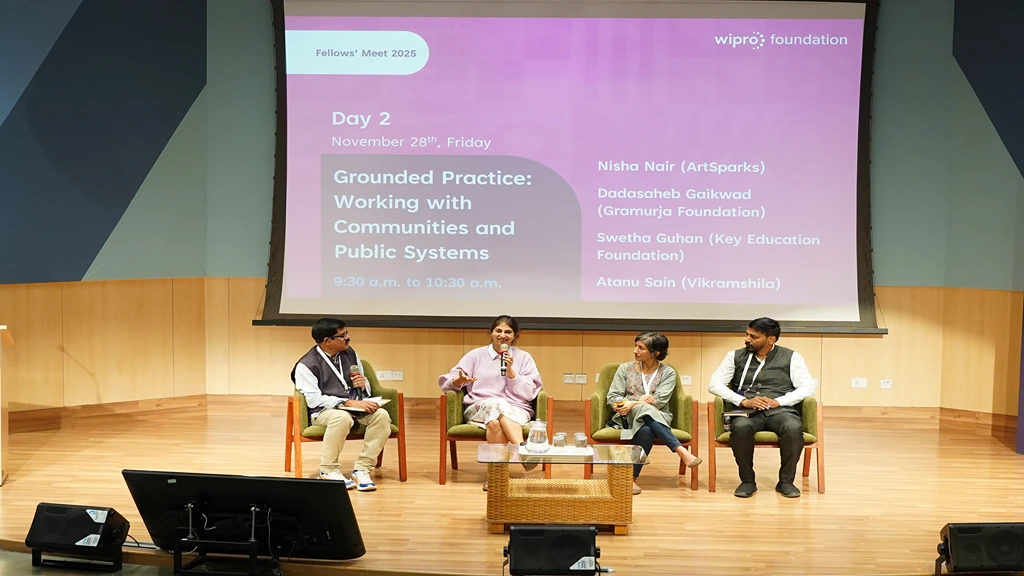
The third panel discussion of the Wipro Education Fellows’ Meet, taking place on November 28, 2025, focused on fostering grounded practices of engaging with communities and governmental systems of education. The panel included Nisha Nair (ArtSparks Foundation), Dadasaheb Gaikwad (GramUrja Foundation), and Swetha Guhan (Key Education Foundation – KEF). The panel was moderated by Atanu Sain from Vikramshila Education Resource Society.
Sharing by the panelists
Swetha Guhan, Key Education Foundation (KEF) – learning from governmental functionaries: KEF started its work in 2016 in low-income private schools in cities. This was because the organization was aiming to intervene in the 3-6 years age group and 50% of these children were in private schools in urban areas. From plugging in products, now the organization’s focus has shifted to cocreating. The child is at the centre of all their interventions, and they cater to the parents’ needs and aspirations as well.
Soon, their work reached 80 low-income private schools. Then, they got permission by the government to work in 35 districts. At the time, in the state they were working in, the DSERT (Department of State Educational Research and Training) did not have much experience in ECCE (Early Childhood Care and Education). In the Department of Women and Child Development that runs the anganwadis, the supervisory cadre existed for ECCE work and so did the understanding and experience of the same. For Val Vatikas in schools, the organization had to create processual structures. This involved learning from the governmental functionaries themselves.
Dadasaheb Gaikwad, GramUrja Foundation – creating community connect: Dadasaheb was inspired in the course of the three years of experience during the Chief Minister’s Rural Development Fellowship Program to start a CSO with his fellow members. The trigger was when he unsuccessfully tried to stop a child marriage. This experience helped him develop the understanding that education is a key enabler. Immersion in enabling processes such as Fellowships helped the co-founders develop relevant understanding and skills through structured learning processes involving other CSOs and mentors.
GramUrja works with parents and other ecosystems across as well. Initially, the organization conducted a one-on-one survey with the parents. This informed their practice in a major way. Parents in the rural areas the CSO works in grapple with some fundamental problems related to health and migration, etc. In the process of intervention Gramurja started developing an understanding of the gap areas. Most of the CSO’s programs are undertaken through partnerships. Being immersed in the community has also led the organization to intervene in issues related to ration cards and Aadhaar, etc. This has helped them slowly get the parents to participate in the CSO’s programs.
Nisha Nair, ArtSparks Foundation – making marginalized women matter in art education: ArtSparks’ work started with a question, “How can school education cater to the development of human capabilities?” As an answer to this question the organization sees the arts as a critical modality for fostering twenty-first century skills. The CSO has set up demonstration centers for best practices in curriculum, pedagogy and students’ learning. In its approach to use the arts as a critical pedagogic space, ArtSparks tries to tread the middle ground between ‘copying the master’ and ‘anything goes’. EdSparks Collective has emerged as one of the ways in which ArtSparks models the building up of partnerships and scales its work.
The CSO started setting up Creative Learning Labs (CLLs), primarily through volunteers in the first year. It was tough to run these through volunteers. Then the organization began to look at community-based models, especially focusing on marginalized women. It started hiring women from the community to run these labs. In the first year, they did curriculum training. In observation visits, the team members started seeing telling signs through the creation of uniform output by the students. Since beliefs influence behavior, the ArtSparks facilitators perhaps believed then that the teacher is the guru and therefore told the children what to do step-by-step. Or maybe they had the idea that capability is finite.
Then, the organization started working on the facilitators’ beliefs and perceptions. Initially, the facilitators believed that joyful learning is about being friendly. Experiences in action research projects and small group learning circles have helped the facilitators to move into the space of facilitating, and not guiding, the students’ learning.
Post-panel discussions
Replying to a question about leveraging governmental funds for anganwadis, Swetha shared that social change happens when there is a felt need. The government must provide funding support for sustained solutions. And the government can pay for only those things for which there is a line item in the budget. To a question on the trade- offs between quality and scale, she responded by saying that one is ready to scale when one if comfortable with not having 100% quality. The way KEF tries to mediate the competing demands between scale and quality is by having 10-12 non- negotiables and monitoring these through rigorous mid-level supervision.
Dadasaheb shared that we must demonstrate tangible changes to the government system, as it has very good eyes and ears. However, it is a slow process.
Nisha shared that to be able to build trust with all stakeholders, including the government and the community, there is a need to constantly gather and share data points. Culminating events that make students’ learning visible are also helpful. ArtSparks holds experiential workshops for parents as well. The organization tries to constantly conduct research and demonstrate change.
[This article was updated last on January 19, 2026.]
Related Articles
By | January 16, 2026
No approved comments yet. Be the first to comment!