
Growing strong by going deep: building educational understanding and capacity within the organization
This piece captures the experiences of three different organizations in building and deepening their own understanding about core educational ideas and philosophies. Their approaches range from responding to community needs and trying to show effective change, to innovating with children’s agency in various kinds of maker spaces to inner work relating to embodying education as freedom.
Introduction
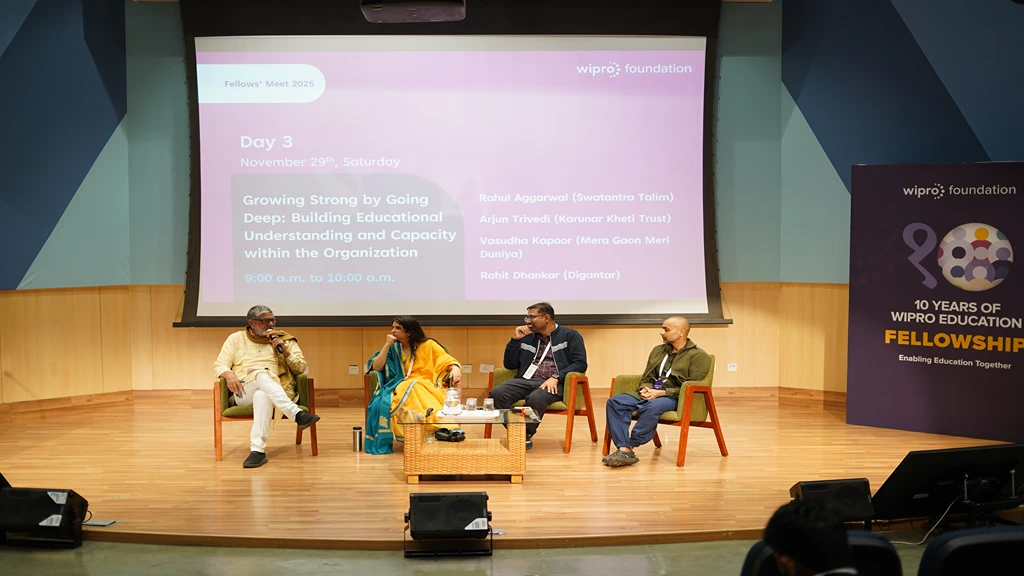
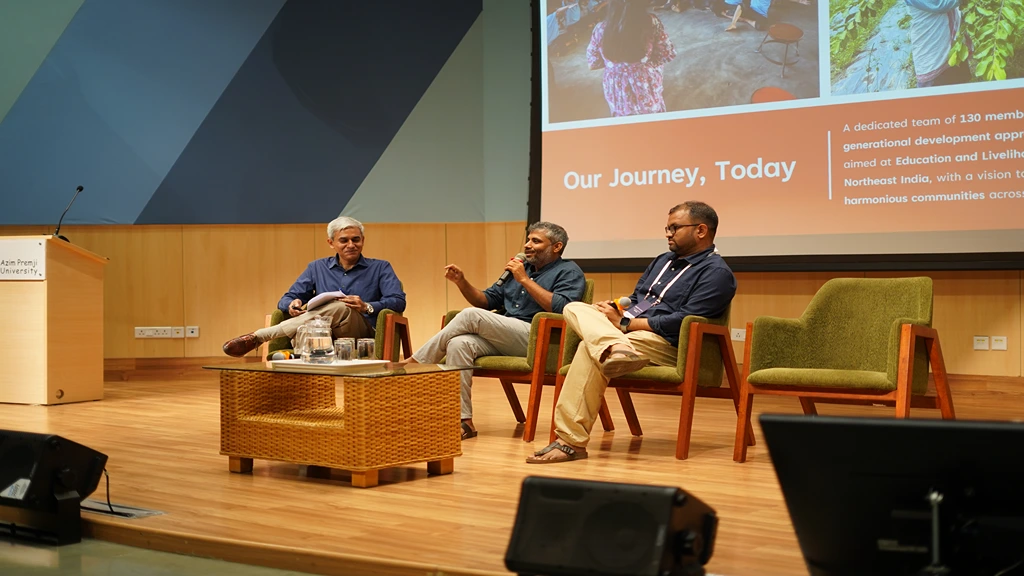
The fifth panel discussion of the Wipro Education Fellows’ Meet, taking place on November 29, 2025, focused on the theme of building educational understanding and capacity within CSOs. The panel included Rahul Aggarwal (Swatantra Talim), Arjun Trivedi (Karunar Kheti Trust-KKT), and Vasudha Kapoor (Mera Gaon Meri Dunia-MGMD). The panel was moderated by Rohit Dhankar, Former Professor at Azim Premji University, and the Founder-Secretary of Digantar.
Sharing by the panelists
Vasudha Kapoor, Mera Gaon Meri Dunia: MGMD works with rural youth. A village is an interconnected system. Systemic change must enable all stakeholders at the village level to engage with the local school to improve it. There also needs to be peaceful coexistence with the governmental system. The CSO’s first intervention was related to education in government schools. This work involved teacher training sessions and learning circles.
The organization has always felt that it is important to teach and create models. For this, exposure to teaching in classes in government schools is essential. The organization commits to take classes for a year and demonstrates the efficacy of the pedagogic strategies it advocates for.
The youth MGMD works with aim to transform their schools. In the youth, the CSO looks for commitment and rootedness in their own villages. Initially the organization undertook demonstration classes for them on purposeful education and activity-based learning. Then, the leaders observed and realized that the participants were trying to mimic the facilitators. This led to further refining of the CSO’s strategy.
Every youth and teacher needs to be grounded in the philosophy of education. There is a need to share the process of deepening understanding and engaged practice with all the stakeholders and carry them along. This has had some demonstrable results as well. In one village, the parents and the local youth together created a kitchen in the government school through their own initiative. This was possible because of youth leadership.
Rahul Aggarwal, Swatantra Talim: Swatantra Talim works in Sitapur district, situated at a distance of 90 kilometres from Lucknow. The quality of education provided by government schools there is low. The organization started with a learning centre in a village in the district with forty children. In the learning centre, they have been working with experiential learning methods. The CSO’s model is to apply education for innovation.
The organization strongly believes that there is a need to develop children’s knowledge through deep conceptual engagement and immersion and reflection on the context. An example of this is when the children Swatantra Talim works with responded to a felt need in the community for charging mobiles and created a solar mobile charger.
These children had experienced freedom in the spaces that the CSO has been creating. This also has involved the freedom to tinker with material and technology. Therefore, the process of creating the solar mobile charger involved simultaneously developing a rigorous understanding of the relevant concepts in physics.
Arjun Trivedi, Karunar Kheti Trust-KKT: KKT’s work has involved creating a space for embodied stillness and mindfulness. Mindfulness is about the mind, the body and the heart, all the three. For the organization, the greatest learning has come from moments of effortlessness.
The CSO as a collective is not focused on ‘doing’ but cultivating the conditions for learning effortlessly and for mindfulness. It is often difficult to express this process in words, as the ultimate goal is to move toward embodying freedom, which is beyond words.
When you embody freedom, you foster curiosity. This leads to wholesomeness which in turn leads to peace. The Selenghat Valley School that KKT runs is built under conditions of fragmentation and conflict. Acceptance of such a school has been a challenge in this particular context.
In conclusion
Deepening educational capacity and understanding can take place under multiple axes. Different organizations are approaching this from multiple angles, depending upon their context and orientation. But at the core is the idea of freedom—the freedom of learners, teachers and facilitators to explore, play, make mistakes and learn.
Related Articles
By | January 16, 2026
No approved comments yet. Be the first to comment!