
The missing middle
This article argues that India’s educational challenge is not inadequate teacher training but the absence of sustained instructional support. It highlights how weak school structures, missing instructional leadership, and limited on-the-ground coaching prevent teachers from translating training into improved classroom practice.
The paradox we do not talk about
India has spent decades building teacher education at scale—B. Ed. programs, in-service trainings, DIETs in every district, national missions with real funding behind them. The infrastructure is vast; the intention has been sincere.
And yet, the Annual Status of Education Report tells us that in 2024, 27% of Grade 3 children in rural India can read a Grade 2 level text (ASER 2024) roughly where it stood a decade ago (ASER, 2014–2024). Twenty years of reform, investment, and training cycles—yet the number moves within the same narrow band.
The sector has largely responded by asking how to train teachers better. There is a prior question, and we have been slow to ask it: what happens after the training ends?
That prior question points somewhere specific. Before we ask how a teacher should be trained, we must ask whether the school they walk into lets them use any of it. Training cannot fix a school that is not built to hold good teaching. Structural reform comes first; teacher training should follow it, not the other way around.
What a teacher actually walks into
Training ends. Posting begins.
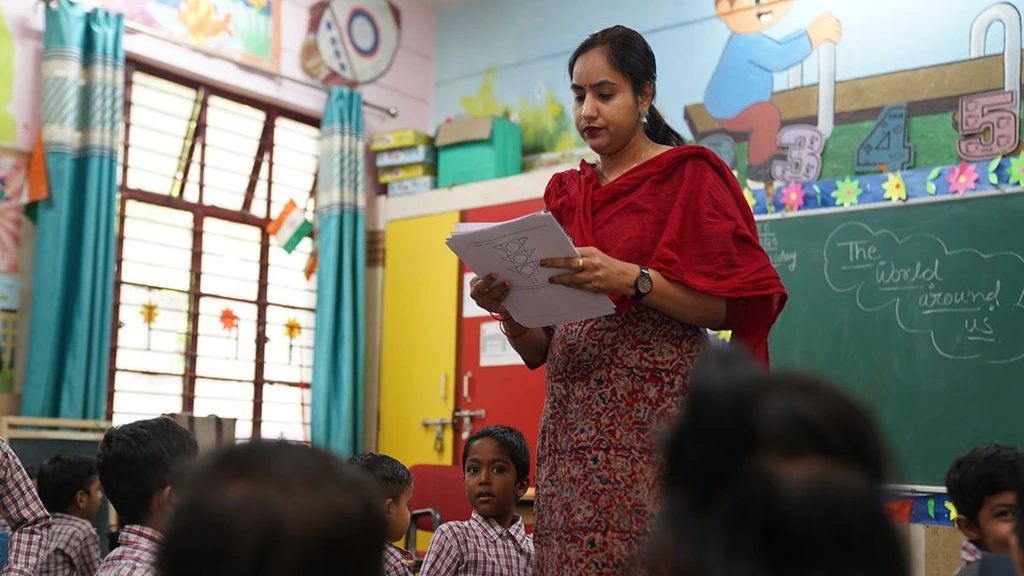
Picture the school. One teacher managing five grades simultaneously. Children at three different learning levels, sitting in the same room. No principal present. Infrastructure that makes sustained instruction difficult. Non-teaching duties eat hours that could have gone to the classroom. Government teachers report spending barely a fifth of their time on teaching (NIEPA).
This is the median reality of government schooling in India. Over 8.5 lakh schools, 58% of all schools in the country enroll fewer than 100 students (UDISE+ 2024–25). At that scale, grade-wise teaching is impossible. A single teacher carries the entire weight of instruction and care.
The training this teacher has received assumed a functioning classroom with a defined grade and a stable institutional environment. For a vast majority of teachers entering government schools in India, that environment does not exist. They were prepared for a school few teachers will find.
None of this is a failure of will. The constraint sits in the structure of the classroom, not in the competence of the person standing in front of it.
The conditions that growth actually needs
There is strong and consistent evidence across professions that training alone does not produce sustained improvement in practice.
Research on teacher development makes this particularly visible. When teachers attend workshops, they apply new skills in the classroom around ten percent of the time. When training includes demonstration and personal feedback, that figure rises to around twenty percent. When a coach enters the classroom, observes the teacher at work, and provides specific and timely feedback rooted in what actually happened in that room, adoption of new practices crosses ninety percent (Joyce & Showers).
The difference is not the quality of the content delivered in training. The difference is the presence of someone watching, responding, and helping the teacher see what they cannot see about themselves. A teacher in a government school in India can spend an entire career without anyone ever entering their classroom to watch them teach and help them get better.
The middle that was designed out
The government system is not without support structures. On paper, there is an entire cascade of roles designed to support teachers’ growth.
The Head Teacher is meant to provide instructional leadership at the school level. The Cluster Resource Centre (CRC) coordinator is meant to mentor across a group of schools. The Block Resource Centre (BRC) and the District Institute of Education and Training (DIET) are meant to organize professional development and anchor teacher education.
Each was designed to sit alongside teachers and help them grow. What happened to each tells us something important.
The principal was made conditional. Under current norms, a dedicated head teacher is only required above enrolment thresholds that 58% of India’s schools do not meet (RTE Act, 2009, Schedule; UDISE+ 2024–25). School leadership became a reward for reaching a certain scale rather than a foundation for any school to function.
The CRC coordinator became an administrator—registers, data, and compliance. Classroom observation—the function at the heart of the role—quietly fell away under the weight of everything else. The BRC became largely a logistics function, and the DIET drifted toward pre-service work, disconnected from the classrooms its graduates entered.
The missing middle is a missing function. Instructional coaching, the sustained and situated support that turns training into practice, has been squeezed out of every role that was designed to carry it. The architecture exists; however, the function has been replaced by administration.
If the school itself is not ready
Deliberate practice requires conditions, not just a willing teacher: a stable classroom, a defined grade, someone whose role is to observe and respond. A school without these cannot adequately support teacher growth. Readiness is the precondition for good teaching, not its outcome.
The question the sector needs to sit with, before the next training program is funded and delivered, is simple: what school is this teacher going back to, and does it have the conditions for them to practice, be observed, and grow?
What designing together actually means
Working with government systems on teacher education is important work. However, if the partnership begins and ends with training design, we solve only the visible part of the problem.
The training conversation is the easier conversation. Governments are generally willing to discuss what teachers need to know, how pedagogy should be structured, how assessments should be designed. These are tractable questions and the sector has become reasonably good at having them.
The harder conversation is the one that follows. What are the structural conditions inside which this training is supposed to come alive? Does the school this teacher returns to have a functioning instructional leader? Does the system treat instructional coaching as a core function or as an optional extra that disappears when external funding runs out?
Organizations in this position have a responsibility to name structural constraints and advocate for change, not just design better training. And in our experience, government partners are more open to that conversation than the sector assumes. Designing together means carrying both agendas into every conversation, not treating them as separate problems.
The close
India does not have a teacher training problem. It has a teacher practice and support problem. The missing middle, the coach, the person whose role is to watch and respond and help a teacher grow, is what stands between a well-trained teacher and one who keeps getting better. We have built the training infrastructure. What we have not built is the institutional culture that treats instructional coaching as a non-negotiable condition of a functioning school.
Every child deserves a school where learning is possible; every teacher, a school where growth is possible. Until we design the middle back in, we will keep filling teachers with knowledge they have nowhere to use.
That is the quieter, harder work in front of us. Not better training, but a system built to let training matter.

Related Articles
By | April 1, 2025
By | April 29, 2026
No approved comments yet. Be the first to comment!