
Together we go far: building and sustaining collectives
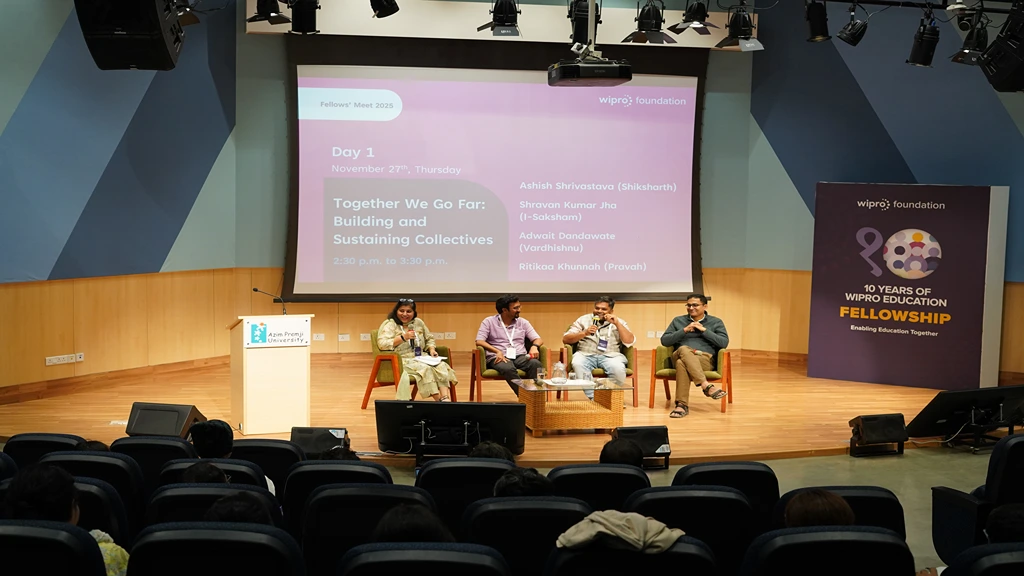
This piece summarizes the reflections from the second panel discussion of the Wipro Education Fellows’ Meet, which took place on November 27, 2025. It dealt with the modalities of sustaining effective collectives of CSOs, so that the member organizations can better serve the communities they work with.
Introduction
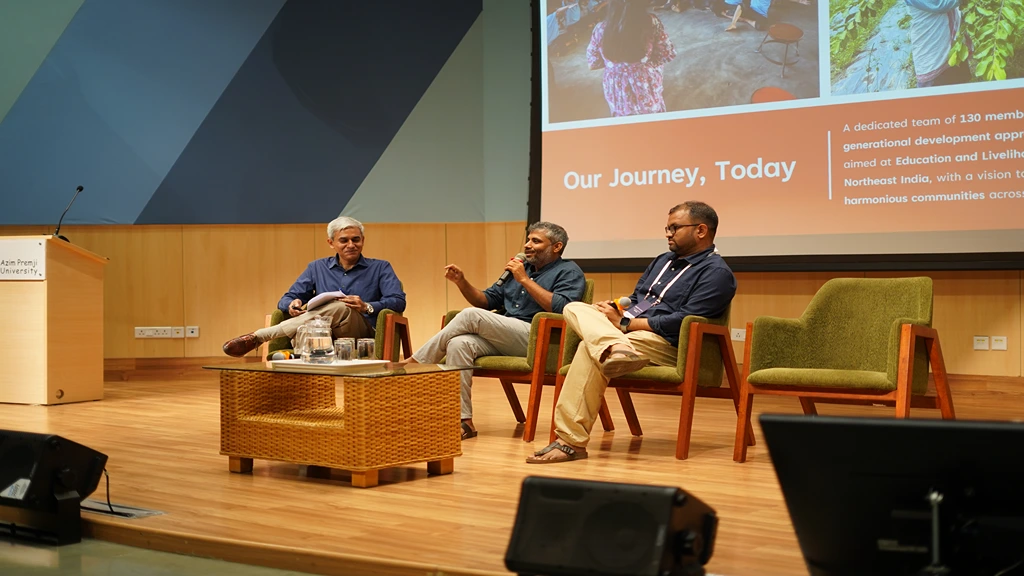
The second panel discussion of the Wipro Education Fellows’ Meet, took place on November 27, 2025. It focused on the process of creating and developing collectives of CSOs that can then act as important spaces for learning, sharing and collaboration. The panel included Ashish Shrivastava (Shiksharth), Shravan Kumar Jha (i-Saksham Education and Learning Foundation), and Adwait Dandawate (Vardhishnu Social Research & Development Society). The panel was moderated by Ritikaa Khunnah from Pravah.
Sharing by the panelists
Adwait Dandawate, member of Community Collectives – connecting grassroots initiatives: Vardhishnu’s work started in 2013. Initially, it involved the running of a handful of learning spaces for children from vulnerable backgrounds in and around Jalgaon. In 2020, the question of scale came up. The team discussed getting into other geographies.
However, very soon, the CSO realized that there are similar initiatives all around. But there are no support systems and capacity-building opportunities for people running these initiatives. These mostly exist for people from metropolitan, English-speaking backgrounds. Vardhishnu then tried to address the question of scale by working closely with these ground-level initiatives to help them develop and sustain their work.
For the last five years, Vardhishnu has been working with organizations at the grassroots level. Eighty percent of these are run with community members themselves, many of whom are first-generation learners. Vardhishnu has catalyzed the process of the creation of these organizations into a collective as well. The members of this collective are running capacity building programs for each other. They are also helping each other with contacts for funding support.
Ashish Shrivastava, member of REACH India Collective – networking remote geographies: Reach India Collective is a group of 16 education-based organizations. All of these work in remote geographies across 12 states in India. The collective’s objective is to build voice and representation for such CSOs. A related goal is to create an ecosystem to support each other. The CSO members of the collective work in remote and rural districts in states and union territories such as Assam, Bihar, Chhattisgarh, Haryana, Ladakh, Madhya Pradesh, Maharashtra, Manipur, Odisha, Rajasthan, Uttarakhand and Uttar Pradesh.
A key driving force of the collective is to amplify the voices of CSOs working in remote geographies. Funders often do not understand the contexts in which such organizations work. The civil society space seems to be dominated by metro-based NGOs. REACH India Collective tries to work as the voice of education NGOs from remote and rural geographies. The members share resources with each other. They also support each other and collaborate to develop interventions at scale.
Shravan Kumar Jha, member of the Bihar Development Collective – creating a developmental ecosystem for the state’s growth: The Bihar Development Collective (BDC) is an initiative of individuals and organizations who have come together to strengthen Bihar’s development ecosystem. The strategy is to create a platform and a community that can support spaces for peer learning, collaborations, mentoring and sharing, which can help in developing critical discourses and practices for the all-round development of Bihar. A key related goal is to change the narrative surrounding the state.
In the NGO sector, while creating collectives, we often start with the wrong question, which is, “What is in it for us as NGOs?”. A better question is, “How can this collective serve the people we serve?”. In 2019, the BDC started with 10 people. Now, at the end of 2025, there are 34 member organizations. The collective meets once every three months. It has a steering committee. The BDC is trying to seed 20 new organizations every year as a collective.
Post-panel discussions
A participant asked the question, “How do you sustain collectives? How do you sustain leadership of these spaces?”
To this, Shravan replied by saying that collectives are as much a collective of people as they are of organizations and institutions. We also need to be aware of politics. An important way in which collectives help the members is by providing spaces for sharing.
Ashish contributed to this discussion by sharing that he has been a part of six collectives. Out of these, two are non-funder driven. Funder-led collectives are fragile. In the 1960s, there were forums that played almost the same role as that of collectives now. Collectives are not new. However, they need to create a sense of possibilities for the members to be able to sustain themselves. Only advocacy does not work. They must provide solutions. Action sustains. We do both micro- and macro- level collaborations. Both are important. Collectives need leadership that is without a face.
Adwait shared that collectives provide a sense of sharing. From the beginning the initiators of the collective were clear that there will be shared responsibilities and action. Now cross-collective work also takes place. It’s only collectives that can help reach the grassroots in very remote geographies. There is also a need to have structures and processes that ensure that everyone becomes a leader.
[This article was last updated on January 19, 2026.]
Related Articles
By | January 16, 2026
No approved comments yet. Be the first to comment!