
An example of adapting schools to children — ‘Jeevan Shiksha Pahal’
This article describes Jeevan Shiksha Pahal, an alternative school run by Muskaan for children from marginalized communities in Bhopal. It highlights how flexible learning, multilingual classrooms, community participation, respectful teacher–child relationships, and connections between education and children's lived experiences can help create an inclusive and meaningful learning environment.
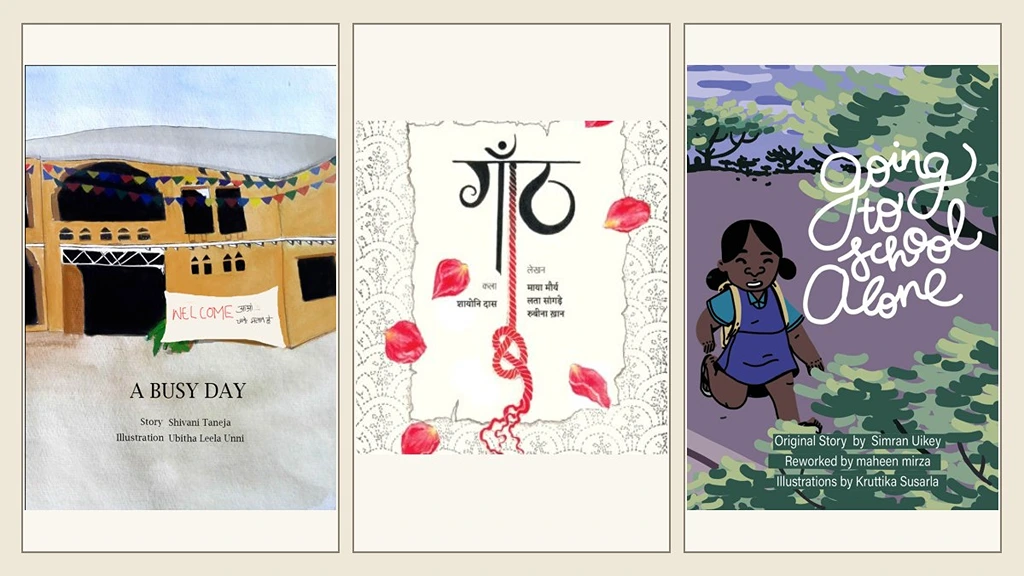
Covers of three children's books published by Muskaan, Bhopal
Muskaan is a non-governmental organization that runs an innovative school called Jeevan Shiksha Pahal (Life Education Initiative). This school is being run for children who are dropping out of school due to various social and political reasons.
The children who come to the school mainly belong to Adivasi (Indigenous), Dalit, and highly marginalized communities living in the settlements of Kotra and MP Nagar in Bhopal. These settlements lack basic amenities such as water, electricity, and toilets. People go out in the open for defecation. Houses are partly permanent and partly temporary; some possess legal land tenure while others do not. The parents of these children are daily-wage laborers, waste pickers, or engaged in similar occupations that provide unstable daily incomes. Looking for work at labor pick-up points is a part of their everyday morning routine. Sometimes they get work and sometimes they do not.
Because of this instability, it becomes difficult for the children of many families to study in regular schools. Most of the children spend their time either trying to earn money themselves, playing around their settlements, or doing household chores such as fetching water and collecting firewood for cooking. More than half of the children collect scrap. Children play an important role in supplementing the family income.
Efforts made during the initial years
In the initial years, we used to teach children within the settlement itself and prepare them for mainstream schools. Once the children became ready, according to their age, for a particular school grade (which did not take much time), we enrolled them in schools. Even without attending school, children would complete learning equivalent to Grades 3 and 4 within a year. Children were enrolled in both government and private schools.
Many efforts were made by Muskaan and the children’s families to ensure that children felt happy and comfortable in school. Parents prepared children for school, packed their lunch, and met school-related expenses despite their limited incomes. Children used to attend Muskaan’s informal centers before or after school and complete the school curriculum there.
Despite these efforts, children did not become fully comfortable in schools. The initial excitement of going to school soon turned into running away from school. Many children were unable to remain in school. Even in the schools where children did stay, it was neither easy nor appropriate to describe the experience they received there as education.
Why were children distancing themselves from schools?
Muskaan tried to understand and experience, at its own level, the reasons why children were not going to school. We spoke with the children and came to understand that nothing was happening in school that attracted them.
The knowledge, language, and culture of these children had no place in the classroom. Children did not understand the activities taking place in class, but they remained silent out of fear. Because of fear, they were also unable to participate in questions and discussions.
The negative attitude of teachers, neglectful treatment by classmates, and ridicule directly hurt these children’s self-respect. As a result, they did not feel motivated either to attend school or to remain there. Despite all this, they made every possible effort from their side to continue attending school. Yet, even after spending one or two years in school, they were unable to learn anything.
How could children feel enthusiastic about going to a place that neither provided opportunities for learning, nor encouraged them, nor protected their self-respect? The adverse circumstances within schools and the neglect faced by children because they belonged to a particular social background pushed them out of school. Until then, we had read about such realities only in books and research papers. The experiences of our children confronted us with the same truth.
While struggling with these circumstances, several questions emerged in our minds:
If a child is receiving so many negative experiences from school, can we, as a system, reject the very existence of school? Can we assume that remaining outside this system would be better for the child’s life?
When a large percentage of children from marginalized communities enroll in schools and face mistreatment there, what should organizations working in education do?
What should be the path between informal education and formal education? Is the model of schooling consisting of ten months, six hours a day, year after year, subject-wise teaching, the only model of education?
Can education be acquired while remaining outside school? Can this be implemented, and will it work?
What kind of education would be useful for children from marginalized communities?
We found answers to some of these questions. In search of answers to others, Muskaan started the Jeevan Shiksha Pahal School in July 2005. We were committed to providing an education that would not only be oriented toward livelihood opportunities but would also help children develop pride in their communities, nurture empathy for the struggles of their own lives, and teach them to raise their voices for their rights. At the same time, they would continue learning with understanding and move forward in life.
A key question for the school has been how it can contribute to the creation of an egalitarian and better society in which working people receive their rightful place. Another challenge has been finding educated individuals who can serve as teachers and creatively integrate these values into classroom practices.
As textbooks, we needed books that would help develop a critical perspective. For this purpose, social studies and civics books published by NCERT and Eklavya are used. Through discussions, we explore issues related to women’s equality, models of development that are making the poor poorer, and similar concerns. These discussions are conducted through films, settlement-based studies, debates, and other methods.
Teaching–learning methods
Here, teachers are free to teach children using their own methods. With some modifications in pedagogical approaches, they are still exploring different meanings and dimensions of meaningful education. Some aspects of the teaching–learning process are shared below.
Children in the school are not divided according to grades because every child has their own pace of learning. One child may learn a particular subject slowly, while another child may learn that same subject quickly and some other subject at a slower pace. In the school, there is a mixed group of 20–25 children in which teachers facilitate the learning process and continue assessing each child’s progress on the basis of predetermined benchmarks. Children learn and progress within their groups with confidence.
In formal school classrooms, children are expected to learn a fixed and limited curriculum within a limited period of time. In contrast, these classrooms provide children with opportunities to learn at their own pace.
Teachers regularly share children’s attendance and academic progress with their parents. Close contact is maintained with both parents and children. If a child does not come to school, teachers visit the settlement and meet the parents to understand the reasons behind the child’s absence and make efforts to reconnect the child with learning.
At times, children do not attend school for long periods of one or two months. However, even after such gaps, if they wish to resume their studies, they return to their school as a matter of right. The school always accepts children. Whenever they want to study, they come to school.
Sometimes children come to school while collecting waste. They leave their sack outside the school and join the learning process. After spending some time in school, they pick up their sack and leave.
Children who are tired from work sometimes study for a while and then fall asleep in a corner of the classroom. After resting and recovering from their fatigue, they rejoin their studies.
Similarly, when parents who are also engaged in waste picking happen to pass near the school, they come in, meet their children, tell a story, and leave. They regard this place as their own. The school belongs to them.
Opportunities for written and oral expression
The classroom provides as many opportunities as possible for children to express their different experiences through writing and speaking. Teachers also listen attentively to children’s thoughts and experiences, which encourages them to express themselves openly.
Teachers type out the experiences narrated by children, whether orally or in writing, and use them as learning material for the children themselves. This helps build children’s confidence.
Giving space in the classroom to issues related to children’s surroundings and their lived experiences is an important part of the teaching process. When this is done, children begin to feel connected to the classroom, and their active participation in the learning process increases.
Giving space to children’s languages in teaching
One of the efforts made toward helping children develop pride in their community and identity, and toward enabling them to understand their marginalization from a political perspective rather than distancing themselves from their roots, is to give an important place to children’s own languages in the classroom. This means using children’s mother tongues as the foundation for teaching them the regional language (Hindi) and the global language (English).
At the initial level, written language is introduced using words from the children’s own language and environment. Small sentences and short stories are used in this process. For example: “Nava dai hatum taal meen tattu.” This is a sentence in the Gondi language that means: “My mother brought fish from the market.” Another sentence is: “Nava dai bhaari boota keta.” This means: “My mother works very hard.” Teachers write such sentences on the board, ask children to read them, and encourage them to draw related pictures. For example, based on the above sentences, children may draw a picture of dai (mother).
Since children have mastery over their own language and possess an immense vocabulary within it, they are able to connect with the sentences they hear in the classroom. This connection motivates them to learn. Children express their thoughts and experiences in their own languages. When a child finds it difficult to understand something, classmates explain it in their shared language in a simpler way. Children also try to learn one another’s languages. This increases mutual respect for each other’s languages and creates a positive learning environment.
When a child’s language finds a place in the classroom, it cultivates respect for their language and culture. It enhances their ability to express themselves, accelerates the pace of learning, and increases participation in teaching–learning activities. They begin to feel that their language is important and has a place in the outside world. In this way, they are able to connect themselves to the school and feel motivated to attend it.
Connecting the classroom with children’s lives and experiences
Children learn most things outside the classroom through the various experiences of their lives. Therefore, an important part of the teaching–learning process is to take children outside the classroom, provide opportunities for them to learn through direct experience and interaction with their surroundings, and make efforts to connect classroom activities with their lives.
In addition, discussions are held with children on various issues that affect their lives. Such discussions help develop children’s ability to question their own circumstances and the conditions around them.
While teaching different concepts in various subjects, children’s experiences and the experiences of their communities are incorporated into the learning process. These experiences include selling water, collecting and selling scrap, selling bel leaves, and carrying electric light fixtures during wedding processions.
Community participation in education
The connection between the community and the school is essential so that the world of reading and writing does not become disconnected from the world of people who have not had access to formal education. For this reason, community members occasionally visit the classroom and narrate stories in their own language. These stories include the community’s own journeys and histories. Sometimes they share incidents from a particular period of their lives, and at other times, they share a skill.
Parents help children in their original forms of expression. Children listen to stories from their parents and then come to the classroom and narrate those stories. In addition, we speak with members of the community and collect stories traditionally told by elders. These stories are translated into the children’s languages and used in the classroom. Community members also participate in children’s fairs (Bal Melas).
When people from the community see their own culture being practiced and valued in the school, they are able to connect with it and develop a sense of cooperation. In this way, the school no longer remains an unfamiliar place for parents. They develop a sense of belonging toward the school and become motivated to send their children there.
They are able to see themselves as connected to the learning process. The feeling that they cannot contribute in any way to education gradually disappears. In this way, their dignity and self-respect are preserved, and their confidence increases.
The trust that the community places in the children and the teachers plays a very important role in helping children learn and remain in school. An example of the connection between parents and teachers can be seen in a statement made by one parent to a Muskaan teacher: “You seem to us as though you belong to our own community.”
Relationships among children
The relationships and friendships among children—including friendships between children from their own communities and those from other communities—have an impact on their learning process.
Among working children, Pardhi children are more frequently engaged in waste-picking work. At times, other children make fun of them or do not include them in group activities. As a result, these children become discouraged, their morale declines, and they begin to avoid participating in group learning.
Deliberate efforts are needed to ensure their acceptance within the group. These children need to be included in the learning process and encouraged to express themselves in the classroom.
Continuous discussions with children, group work in the classroom, and visits to different settlements are all very useful in increasing the acceptance and participation of all children in the classroom. Gradually, friendships develop among children, and they begin helping one another in learning. This creates an inclusive learning environment in the classroom.
Relationships between teachers and children
For teaching and learning activities to be carried out effectively, it is essential that the classroom environment be free from fear, because learning becomes difficult in a state of fear. For this reason, it is very important that the relationship between teachers and children be extremely warm and friendly.
Conversations take place between teachers and children not only about academic matters but also about their personal lives. During circle time (sitting together in a circle for discussion), conversations are held on a variety of topics, such as:
· What changes have you noticed in yourself over the past few months?
· If you wanted to give a suggestion to a child or teacher in your class to help them improve a particular behavior, what suggestion would you give?
In addition, discussions are held about children’s relationships with their family members. Children share their thoughts and life circumstances with teachers without hesitation. Sometimes children do not feel comfortable expressing themselves in a group. In such situations, teachers speak with them individually. Teachers listen to children with sensitivity and try to provide them with emotional support.
These discussions help develop deep relationships between teachers and children, and children are able to speak openly with their teachers. An egalitarian relationship between teachers and children makes the process of learning much easier. To keep parents informed about their children’s progress, teachers visit children’s homes every Saturday and meet with parents to share updates about their development.
Teachers give space in the classroom not only to their own understanding and knowledge but also to the understanding and knowledge of the children. During language teaching, when teachers do not understand the children’s language, they learn it from the children. In the process of translating Hindi sentences into the children’s languages, it is the children who play the leading role. In this way, learning is not one-sided but two-way. Sometimes children are learning from teachers, and at other times teachers are learning from children.
The relevance of the current education system for marginalized communities
The current education system has been designed according to the needs of a particular social class. The majority of children from marginalized communities continue to be excluded from this system.
The few children who are able to adapt themselves to this mainstream education system often become disconnected from their roots. This mainstream educational arrangement is not suitable for these communities.
The experiences that these children receive in schools, and the teaching materials used in classrooms, are neither relevant nor meaningful for them. There is a need for fundamental changes in the education system in accordance with the needs and experiences of these communities.
Education of children from marginalized communities
In the process of learning, a person’s own effort is important, but the environment of the learning space and the teaching–learning process also have a significant influence on learning. The more inclusive the learning process is, the more motivated children will be to learn.
To improve the education of children from marginalized communities, changes must be made in teaching methods, and greater flexibility must be introduced into the curriculum. Schools need to become places where children can proudly share their identity, their work, and their experiences.
In order for children to participate in learning with confidence and joy, it is very important to connect the classroom with children’s lives and to bring their living experiences into the classroom. Schools should strive to contribute to the creation of a more equal and better society. Our school is a small effort in that direction.
Bibliography
· Bacche Ki Bhasha Aur Adhyapak (The Child’s Language and the Teacher) — Krishna Kumar
· Bhasha Shikshan (Language Teaching) — Maya Maurya and Savita Sohit
· Pedagogy of the Oppressed — Paulo Freire

Related Articles
By | April 29, 2026
By | July 2, 2023
No approved comments yet. Be the first to comment!