
Building the core: people, resources and culture
This article summarizes the reflections from the first panel discussion of the Wipro Education Fellows’ Meet, which took place on November 27, 2025. It focused on some fundamental aspects of developing an organization in the social sector.
Introduction
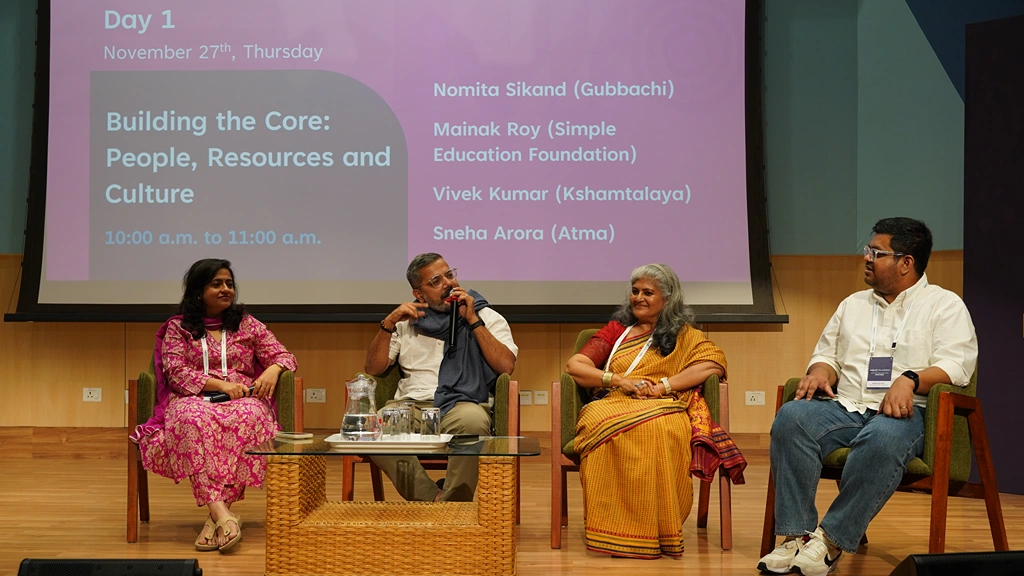
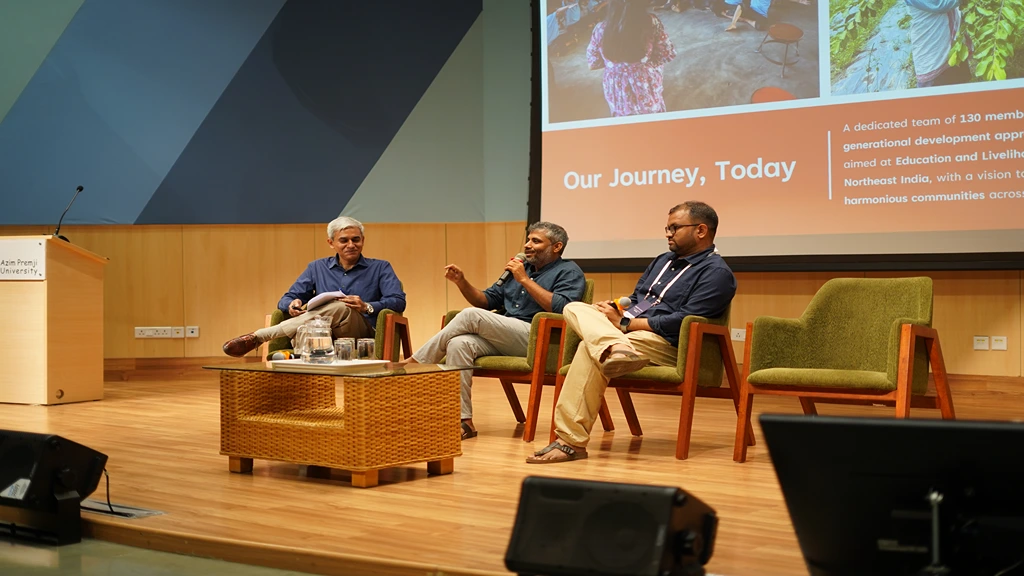
The first panel discussion of the Wipro Education Fellows’ Meet, taking place on November 27, 2025, focused on some fundamental aspects of developing an organization. These include people practices, resource mobilization and creating a robust organizational culture. The panel included Nomita Sikand (Gubbachi), Mainak Roy (Simple Education Foundation-SEF), and Vivek Kumar (Kshamtalaya Foundation). The panel was moderated by Sneha Arora from Atma.
Sharing by the panelists
Nomita Sikand, Gubbachi – building a culture of learning: From the very beginning, the founding team realized that building capacity was critical. Now the Gubbachi team has around 170 members. Therefore, keeping everyone aligned to the organization’s vision has become even more critical. The talent the CSO recruits is largely drawn from the communities it works with. Capacity building is thus critical, so that these team members can succeed in their roles.
Gubbachi also sees learning and capacity development as an integral part of evolving a robust organizational culture. It has a dedicated ‘Learning and Development’ person. Every team member has opportunities for participating in workshops. The larger values of the organization anchor its initiative in learning and development, and in capacity building as well. Helping people reflect on organizational values and understanding personal and professional differences are also seen as important parts of the process of learning for team members.
Mainak Roy, SEF – resource mobilization for realizing the vision: At SEF, fundraising is an organizational effort. Everyone has some part of it. The CSO’s growth has been slow, incremental and organic. A key challenge, and an area of continuous positive change, has been around the barriers that the team members mentally have had regarding asking for support from external stakeholders for organizational work. SEF has tried all avenues of resource mobilization, including grants, CSR support and crowdfunding.
There have been challenges in this model of distributed responsibilities for fundraising. The co-founders still do share an important part of the work in resource mobilization. However, equally important has been developing an understanding of the areas of education the CSO intervenes in.
Vivek Kumar, Kshamtalaya – people management in diverse geographies: Kshamtalaya’s work now spans rural Udaipur, the interior tracts of Bihar and Delhi. In this context of diverse and distant geographies, having a robust people management strategy has been critical. If the co-founders want to realize the organization’s vision, one must build a team. A central part of this process has been finding and developing talent. Kshamtalaya looks for alignment with the organization’s values and basic competencies. At the time of recruitment, this is sought to be ensured by a series of long-ranging conversations. Once talent is hired, the organization tries to retain it at any cost.
In talent development, one must be ready for failures. It’s possible to be a generalist, only if one is an expert in something. But expertise takes time to build. Hence, one must trust the people and the process. Trust is a core value and a key element of practice at Kshamtalaya. All the organization’s meetings are open spaces where everyone can participate. However, functional hierarchies do exist. Building talent for leadership transitions lies in the details. It’s not possible to plan for everything.
Post-panel discussions
A question was raised by a participant with respect to relationships with funders and when one can and does say ‘no’ to funds. To this, Nomita replied that it is important to have honest conversations with funders. Mainak responded that retention has been the key to SEF’s fundraising strategy. The CSO has said ‘no’ to funding when their values did not match with the funder’s. Never scaling before sustaining existing work has been something that has helped them do this.
Another question was raised about coping with the sheer volume and diversity of work as co-founders of CSOs in the initial years and about managing the initial fundraising. To this Nomita replied saying that Gubbachi was especially lucky in having six committed co-founders. In managing work in the initial years, switching roles is fine. One must also reach out and take support from others. Vivek responded by sharing that starting small and distributing responsibilities and financial powers also help. Maintaining financial transparency also contributes to building ownership. Mainak offered that co-building organizational culture and values is critical. He also shared that asking the question, “Where am I useful?” is an important one for co-founders.
To a question related to organizational culture and values, Nomita responded by saying that values are not something one does once a year. For creating an organizational culture that helps in maintaining the CSO’s values and in being faithful to its mission, continuous conversations and helpful routines are a must.
Related Articles
By | January 16, 2026
No approved comments yet. Be the first to comment!