
Why we need to understand the lives of frontline government officials
This is the first part of a conversation between Yamini Aiyar and Rahul Mukhopadhyay. It takes Aiyar’s recent book 'Lessons in State Capacity from Delhi's Schools' as a starting point. The conversation explores her in-depth experience of working with the education administration system and shares the insights this experience has for civil society organizations (CSOs).
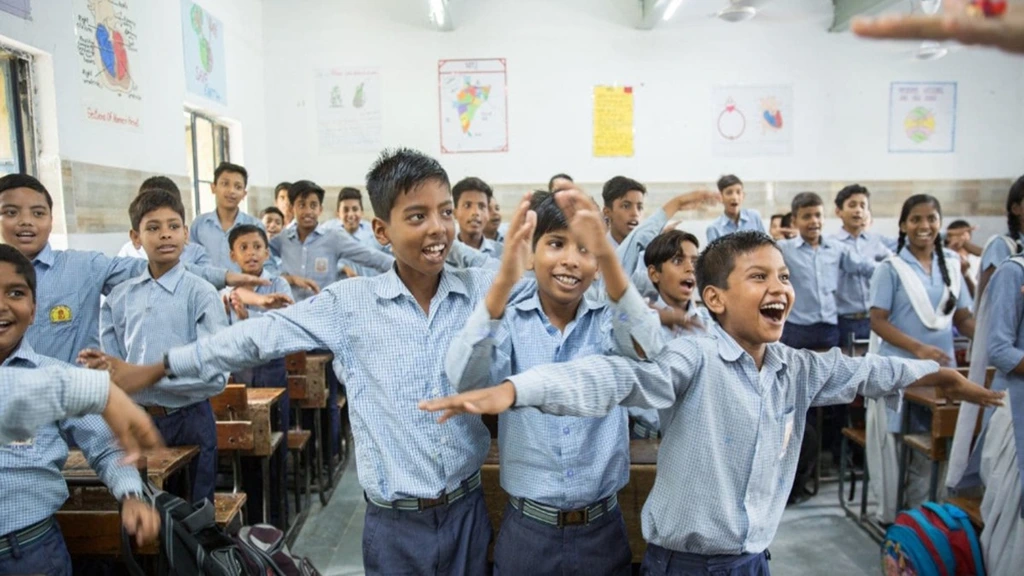
Happiness activity in a government school in Delhi
Photo credit: commons.wikimediaa.org/Government of NCT of Delhi
Rahul Mukhopadhyay: Yamini, congratulations on the book. It has been about two years now since it was published, and I dive straight into the book itself. In the volume, you have looked at the entire state education machinery, though limited to a particular geography. There could be particularities of this geography and this intervention that may not be generalizable. But what broad learnings would you say your book has for civil society organizations working with different levels of the school administration system?
Yamini Aiyar: Thank you. I think the most important thing that I learned from the process is being sensitive to what we hear in the field without any presuppositions and the constraints under which the government is operating. As civil society organizations, our role is very much to serve as a watchdog to the government, to speak truth to power, and to innovate outside of the government system.
In some sense, at the risk of generalizing, civil society organizations often see themselves either operating in parallel to or in conflict with the State. These are important roles. And we should not give up on the core purpose of who we are. However, to understand what it takes to make change, we also need to be open to engaging with the constraints and conditions under which the State operates.
When we talk about the frontlines of the State, as we do quite extensively in political sociology, what we really mean are those people who are tasked with doing the State’s work on the ground. At one level, there are the policymakers who sit in AC rooms. Then, there is the middle tier that is thinking about the rules to implement the policy. And then there is everybody else—from the schoolteacher to the headmaster to the block education officer (BEO) and so on—who are the ones who are implementing. And they (the last tier) are the ones who engage with society, who engage with citizens the most. In some sense, they are the most important part of the government education administration system. In general, if you think about the discourse that we use, to engage with, to describe, and importantly, to work with, we often cast the frontline as the problem.
Rahul Mukhopadhyay: But as your book reveals, that’s not the full picture of the situation on the ground? Isn’t it?
Yamini Aiyar: It is true that there is a large amount of corruption and apathy. Sometimes, there is a lack of even basic things like showing up to work. Absenteeism is a serious problem. And dynamics related to caste and gender, etc. are also factors in how the frontline engages with the most vulnerable of citizens. And, so, we see them in some ways as the beginning of the problems that we have with the State.
Within the State as well, at every level of the system, we see how a minister might say I cannot get anything done because of my secretary (the Education Secretary). The MP (Member of Parliament) may say I cannot get anything done because of the bureaucracy. The IAS officer might blame the junior officer, and the junior officer may blame the district officer.
So, it is this cascade where we see all levels of the State as a problem. And one of the things that I learnt is in terms of shifting my priors. That is to say, okay, everywhere I go, I see this government officer, dripping in power, ‘lal batti ki gaadi leke har jagah ghum rahe hain’ (They are going around everywhere in cars with red lights). This officer wants to be a part of the government to have access to the State’s power. And yet, when we would start talking to them about their daily lives, their work, they would always talk about themselves and their work from a vantage point of powerlessness.
Rahul Mukhopadhyay: This is a very interesting insight. How do we understand this?
Yamini Aiyar: Now, very often we dismiss this as yet another excuse. It is very easy to say, “I am a cog in the wheel, and, therefore, I cannot change anything.” But I cast myself in their shoes for a moment and asked myself, “If somebody from the outside comes to ask me about my daily job when I am projecting power and status to everyone, would I admit that I actually do not have any control?” And, so, I said, “Okay, let me start thinking about this a little bit more.”
And the more we scratched the surface, the more we began to realize the extent to which autonomy and a sense of fulfilment actually does not exist in the everyday jobs of our frontline. Which is why they are very often able to legitimize this attitude of “Sarkaar chahti hai, toh bahut kuchh kar sakti hai” (If the government wants, it can do a lot), “magar mere se kuchh nahi hoga; jab tak adesh nahi aayega tab tak hum aage badh nahi sakte” (But I cannot do a thing. Until I get an order, I cannot move forward).
And the puzzle which I began this work with was just this—why is it that these very officers whose entire external persona is about embodying the State’s power, in their everyday conversations go behind this veil of power and end up saying, “Actually, I am also a powerless actor.”
So, what I was trying to understand is then how do they behave when they are tasked with a job. Our general reaction is, “How can I bypass this officer, who is not empathetic, who is not sympathetic, who does not believe in the purpose of their role and seems to be drunk on the State’s power?” Maybe we need to think about it slightly differently and understand what their daily lives are, because only then can we collectively coproduce positive outcomes for all.

Related Articles
By | April 29, 2026

By | October 24, 2024

By | April 29, 2026
No approved comments yet. Be the first to comment!